작성자: Kai Life Editorial Team
A simple monthly receipt archive can be created in 15 minutes by gathering the month’s receipts, separating items by action, recording only useful details, and storing the final notes in one consistent place. The aim is not to build a detailed accounting system. It is to make household spending records easy to find when you need to check a purchase, notice a recurring payment, or compare one month with another.
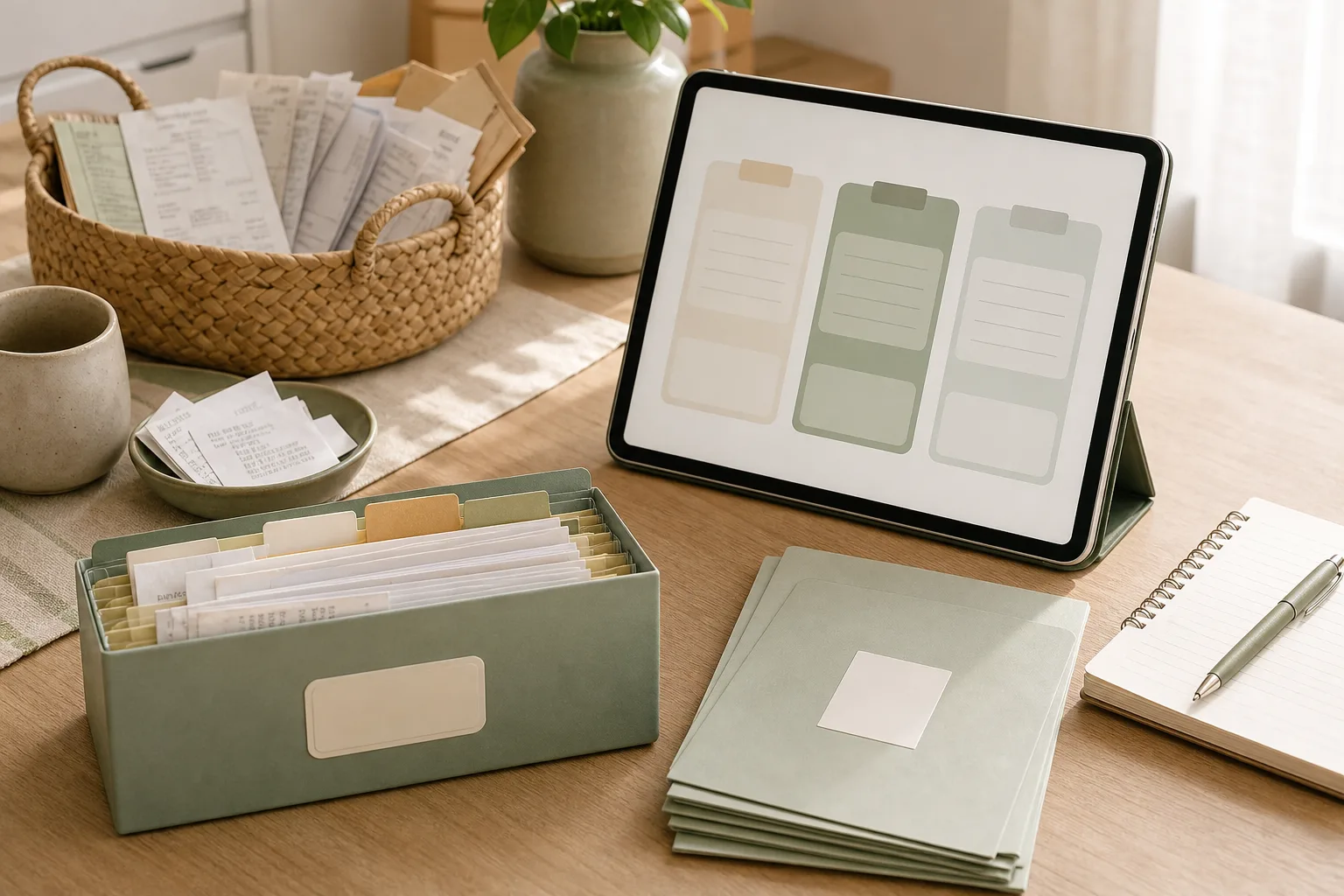
Why a small archive is easier to maintain
Receipts become difficult to use when they are scattered across wallets, bags, email inboxes, shopping apps, and screenshots. A monthly archive gives each record a clear home and a short review point. It can also separate three different needs that are often mixed together:
- Reference: keeping enough information to identify a purchase later.
- Action: marking a receipt that needs a return, warranty check, reimbursement, or follow-up.
- Awareness: recording patterns such as subscriptions, routine bills, or unusually large household purchases.
Keeping those purposes separate helps prevent over-recording. A receipt that only needs to be found later may need a date, merchant, amount, and short note. It may not need every product line copied into a spreadsheet.
The Prepare–Sort–Act–Review framework
1. Prepare: create one monthly landing place
Choose one physical or digital location for the month. This could be a labeled envelope, a folder, a note, or a spreadsheet tab. Use a naming pattern that is easy to scan, such as 2025-03 Household Spending. The specific tool matters less than having one predictable destination.
Before starting, collect the records that are easiest to overlook:
- Paper receipts from wallets, bags, or drawers.
- Email receipts and order confirmations.
- App purchase histories or screenshots.
- Notes about cash purchases.
- Recurring payment notices that arrived during the month.
Set a timer for 15 minutes. The time limit keeps the task focused on useful organization rather than a complete reconstruction of every transaction.
2. Sort: use three action piles
Sort each record into one of three groups:
| Group | Use it for | Next step |
|---|---|---|
| Keep | Purchases that may be useful to reference later | File or save a short record |
| Act | Returns, missing items, warranty questions, or reimbursements | Add a clear follow-up note |
| Discard or merge | Duplicates, unreadable scraps, or records already stored elsewhere | Remove only after checking for a useful copy |
When a purchase exists in both paper and digital form, keep the format that is easier for the household to retrieve. If a physical receipt contains information that is not visible in the digital copy, retain the physical version or add a note before disposing of anything.
3. Act: write the minimum useful record
For each item in the Keep group, record a small set of details. A practical entry can include:
- Date or month
- Merchant or service name
- Amount, if relevant to your household review
- Category or purpose
- Return, warranty, reimbursement, or other follow-up date
- A short identifying note, such as “replacement filter” or “school supplies”
Use plain descriptions that another household member can understand. “Home item” may be too vague six months later, while “kitchen storage container” is more useful. The note should identify the purchase without requiring a long explanation.
Recurring payments deserve a separate mark. Add a small label such as recurring or renewal when a charge repeats monthly, annually, or on another schedule. This does not require a financial analysis. It simply makes repeated charges easier to spot during a later review.
4. Review: close the month with a short check
Use the final minutes to check whether the archive answers the questions your household is likely to ask. For example:
- Can we identify the source of this purchase?
- Is any receipt waiting for a return or other action?
- Did we record the recurring payments that need attention?
- Are there duplicate records that can be merged?
- Would another person find this archive without asking where it is?
If a record does not answer a realistic question, avoid adding detail simply to make the archive look complete. The purpose is retrieval and review, not creating a second copy of every shopping history.
A timed 15-minute action plan
This schedule can be adjusted to fit the number of records in the month.
| Time | Task | Output |
|---|---|---|
| Minutes 0–2 | Open the monthly folder or prepare the envelope and gather loose records | One working area |
| Minutes 2–6 | Separate records into Keep, Act, and Discard or merge | Three clear groups |
| Minutes 6–11 | Record the minimum useful details for Keep items | A searchable monthly list |
| Minutes 11–13 | Mark recurring payments and follow-up items | Visible action labels |
| Minutes 13–15 | Complete one action and store the archive | A closed monthly routine |
If the timer ends while records remain, stop at a sensible point and label the unfinished group. You can carry it into the next session rather than allowing the archive task to expand without a boundary.
Copyable monthly archive table
Use this table as a starting point. Remove columns that do not help your household and add a column only when it supports a repeated decision.
| Date | Merchant or service | Amount | Purpose | Recurring? | Action or note |
|---|---|---|---|---|---|
| YYYY-MM-DD | Yes / No | ||||
| YYYY-MM-DD | Yes / No | ||||
| YYYY-MM-DD | Yes / No |
For a paper-first system, the same information can fit on a monthly cover sheet. For a digital system, use a note or spreadsheet that can be searched by merchant, purpose, or month. Avoid mixing personal notes with sensitive payment details that are not needed for household organization.
Decision rules that keep the routine simple
Keep a receipt when it has a future use
A record is more useful when it supports a likely future task: finding purchase information, checking a return window, identifying a replacement item, or answering a household question. If the receipt has no practical reference value and another reliable record already exists, it may not need a separate duplicate.
Write a note when the receipt is unclear
Some merchant names do not explain what was purchased. Add a short purpose note while the transaction is still familiar. This is particularly helpful for mixed shopping trips or orders containing several household items.
Separate follow-up from storage
A filed receipt can disappear from attention. An action note should state what needs to happen and when you plan to revisit it. For example, “check return status on Friday” is more useful than “return?” A calendar reminder may be appropriate for an item with a time-sensitive follow-up.
Use categories that match household decisions
Categories should help you review records, not reproduce a complicated accounting chart. Examples include groceries, household supplies, transport, children’s items, personal care, and home maintenance. If two categories lead to the same decision, combine them.
Monthly checklist
- Choose the monthly folder, note, envelope, or table.
- Gather paper, email, app, and cash-purchase records.
- Sort each item into Keep, Act, or Discard or merge.
- Record the date, merchant, amount, purpose, and useful note.
- Mark recurring payments or renewal-related records.
- Write a specific follow-up for every Act item.
- Remove duplicates only after confirming another copy is available.
- Store the finished archive where household members can find it.
FAQ
Should every receipt be entered?
No. The archive can focus on records that support retrieval, follow-up, or a household review. The right level of detail depends on how your household uses the records and how much information is already available elsewhere.
Is a spreadsheet required?
No. A folder, note, envelope, or paper cover sheet can work. Choose a format that is easy to update and easy for the people in the household to locate.
How should digital and paper receipts be combined?
Choose one monthly location and add a short pointer when the original stays somewhere else. For example, a monthly note can state that the full digital receipt is in a named email folder. Avoid saving several indistinguishable copies without a reason.
What if the archive is already several months behind?
Start with the current month and create a short backlog list for older records. Prioritize items connected to an open action or a likely future question. A complete historical archive is not required to begin a usable routine.
Conclusion
A monthly receipt archive works best when it reduces searching rather than adding another demanding chore. Gather records in one place, sort them by action, record only useful details, mark recurring payments, and close the session with a short review. Repeating the same four steps gives household spending organization a stable shape while leaving room to adjust the format to your household’s actual needs.