작성자: Kai Life Editorial Team
A useful home organization rule for a small home is simple: place an item as close as practical to the point where it is used, not merely where there is an empty shelf. In a 15-minute tidy-up, you can identify a few repeated trips, sort the items involved, move them closer to their work area, and review whether the new arrangement makes sense for daily life. This approach is especially useful in one- or two-person homes, where a small change in the location of keys, cleaning supplies, chargers, or cooking tools can affect the home’s flow.
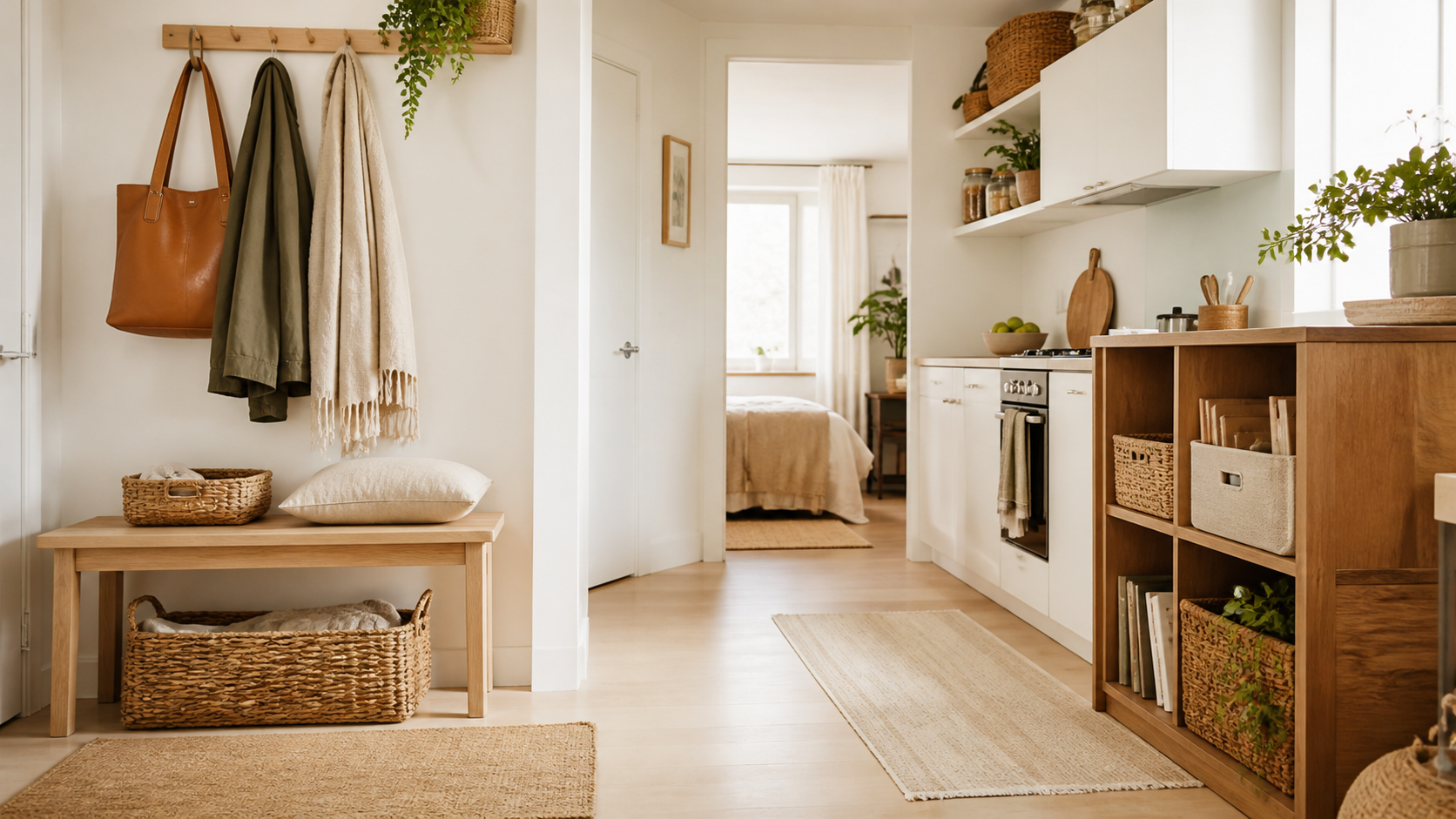
The placement rule: organize around movement
Many storage decisions begin with appearance: an open surface looks cluttered, so everything is placed out of sight. That can create a second problem. If an item is hidden far from where it is used, you may walk back and forth, leave it on a temporary surface, or forget where it belongs.
Instead, look at the short routes you repeat during an ordinary day. Examples include:
- Door to key storage, bag storage, or shoe care.
- Sink to dish towel, drying area, or cleaning supplies.
- Desk to charger, notebook, or headphones.
- Bedside area to glasses, medication packaging, or reading material.
- Laundry area to hamper, drying space, or folding surface.
The aim is not to keep every object visible. The aim is to give frequently used objects a clear home near the activity that needs them. Items used less often can usually tolerate a less convenient location, provided that the storage place is labelled by function or easy to remember.
A 15-minute home organization routine
1. Prepare: choose one route
Set a timer for 15 minutes and choose one small route, such as the entrance, desk, kitchen counter, or bedside area. Avoid attempting the whole home in one session. A narrow focus makes it easier to see which items are causing repeated movement or surface clutter.
Prepare three temporary groups:
- Keep here: items that are used in this area and have a sensible location nearby.
- Move closer to use: items that belong in the area but are stored too far away.
- Review later: items that need a decision about frequency, ownership, or disposal.
You do not need new containers for this exercise. Use the existing shelves, drawers, hooks, or a temporary box while you test the arrangement.
2. Sort: notice repeated trips
Look at the selected area and ask four questions:
- What do I reach for here?
- What do I carry into this area from somewhere else?
- What do I leave here because returning it is inconvenient?
- Which item has no clear next destination?
Write down two or three examples. A short note such as “charger is used at the desk but stored in the bedroom” is enough. This keeps the exercise focused on observable routines rather than an idealized room.
3. Act: move the highest-friction items first
Choose one to three items that create the most repeated movement or temporary piles. Move them to a location that is:
- Near the point of use.
- Easy to reach without moving several other objects.
- Appropriate for the item’s safety and condition.
- Simple enough that another household member can understand it.
For example, a notebook used at a desk can stay in a desk drawer rather than on a distant bookshelf. A small cleaning cloth used near the kitchen sink can have a nearby hook or designated shelf. A bag used when leaving home can be placed near the entrance, if that location does not block the walkway.
Keep the arrangement modest. The purpose of this session is to test a route, not to redesign every storage area. If moving an item creates a safety concern, obstructs a passage, exposes it to moisture or heat, or makes it harder to secure, choose a different location.
4. Review: run the route once
After making the changes, imitate the activity that normally creates the clutter. Sit at the desk and collect the items you use there. Enter the home and put down your bag and keys. Prepare a simple drink and return the tools to their places.
Ask:
- Can I reach the item without an unnecessary detour?
- Can I return it with one clear action?
- Is the new location visible or memorable enough?
- Did the change create a new obstacle somewhere else?
If the arrangement feels awkward, adjust one item at a time. A location that looks efficient on paper may not fit the way the room is actually used.
Copyable 15-minute checklist
| Time | Action | Prompt |
|---|---|---|
| 0–2 minutes | Choose one route | Which small area causes repeated movement or temporary piles? |
| 2–5 minutes | Gather and sort | What belongs here, what needs to move closer, and what needs later review? |
| 5–10 minutes | Change locations | Which one to three items would benefit from a shorter path? |
| 10–13 minutes | Return related items | Can each item be reached and put away with a clear action? |
| 13–15 minutes | Test and note | What worked, and what should be adjusted during the next reset? |
You can copy this shorter version into a note:
- Area: ____________________
- Repeated trip I noticed: ____________________
- Item to move closer: ____________________
- New location: ____________________
- Test result: ____________________
- Next small adjustment: ____________________
Storage rules that support home flow
Give frequent items the easiest access
Items used every day benefit from a location that is quick to reach and easy to restore. This may be an open tray, a front section of a drawer, or a hook at a natural stopping point. Convenience can reduce the temptation to leave an item on a table or counter.
Group items by activity, not only by object type
Keeping all similar objects together can be useful, but activity-based grouping may be more practical in a small home. For example, the objects used for preparing coffee can share a zone even if they are different types of items. The same idea can apply to a work-from-home kit, an entryway kit, or a basic cleaning kit.
Keep a small buffer near busy surfaces
A busy surface often needs a temporary landing place. A small tray or clearly defined section can hold items that have entered the room but are not ready to be put away. The buffer should be limited enough to reveal when it needs attention. It is a holding zone, not a replacement for storage.
Separate daily access from occasional storage
Do not give prime storage space to items that are rarely used if daily items are difficult to reach. Place occasional items higher, farther back, or in a less convenient cabinet when their condition and safety allow. Keep the most accessible locations for the routines that happen frequently.
Common mistakes to avoid
- Changing too many areas at once: A large rearrangement makes it difficult to tell which change helped.
- Choosing a location only because it is empty: Empty space may be far from the activity or inconvenient to restore.
- Buying organizers before observing the route: A new container cannot correct an unclear storage rule.
- Ignoring other household members: A system works better when its locations are understandable to everyone who uses them.
- Keeping a temporary pile without a review point: Add a short review time so the pile does not become permanent.
Conclusion: make one route easier
Effective home organization in a small home can begin with one repeated route rather than a complete makeover. Choose a small area, identify the objects that travel unnecessarily, move a few of them closer to their point of use, and test the result. The goal is a home flow that supports real routines, including imperfect days. Repeat the 15-minute process in another area when the first change has had enough time to show whether it fits.
FAQ
Should every item be stored near where it is used?
No. Prioritize items used frequently or items that create repeated trips and surface clutter. Infrequently used belongings can stay in more remote storage if the location is safe and easy to remember.
What if there is not enough storage near the activity?
First, review whether the area contains items that belong elsewhere. Then consider a small existing shelf, drawer section, hook, or tray. If no suitable location exists, use a clear portable group for that activity and review whether it is helping before adding more equipment.
How often should I repeat the 15-minute routine?
Repeat it when a route begins producing the same temporary pile or repeated search. A short session can also be useful after a change in work schedule, household membership, or room use.
What is the best place for items shared by two people?
Choose a location that both people can reach and recognize. If the item is used in two separate areas, keep a small shared location near the more frequent activity and agree on the return rule.