작성자: Kai Life Editorial Team
Household spending organization becomes easier when the goal is not to record every detail, but to create a useful monthly picture. A simple 15-minute routine can help you gather recent spending records, group them into a few practical categories, identify recurring payments, and choose one follow-up action. The method below uses four steps: prepare, sort, act, and review.
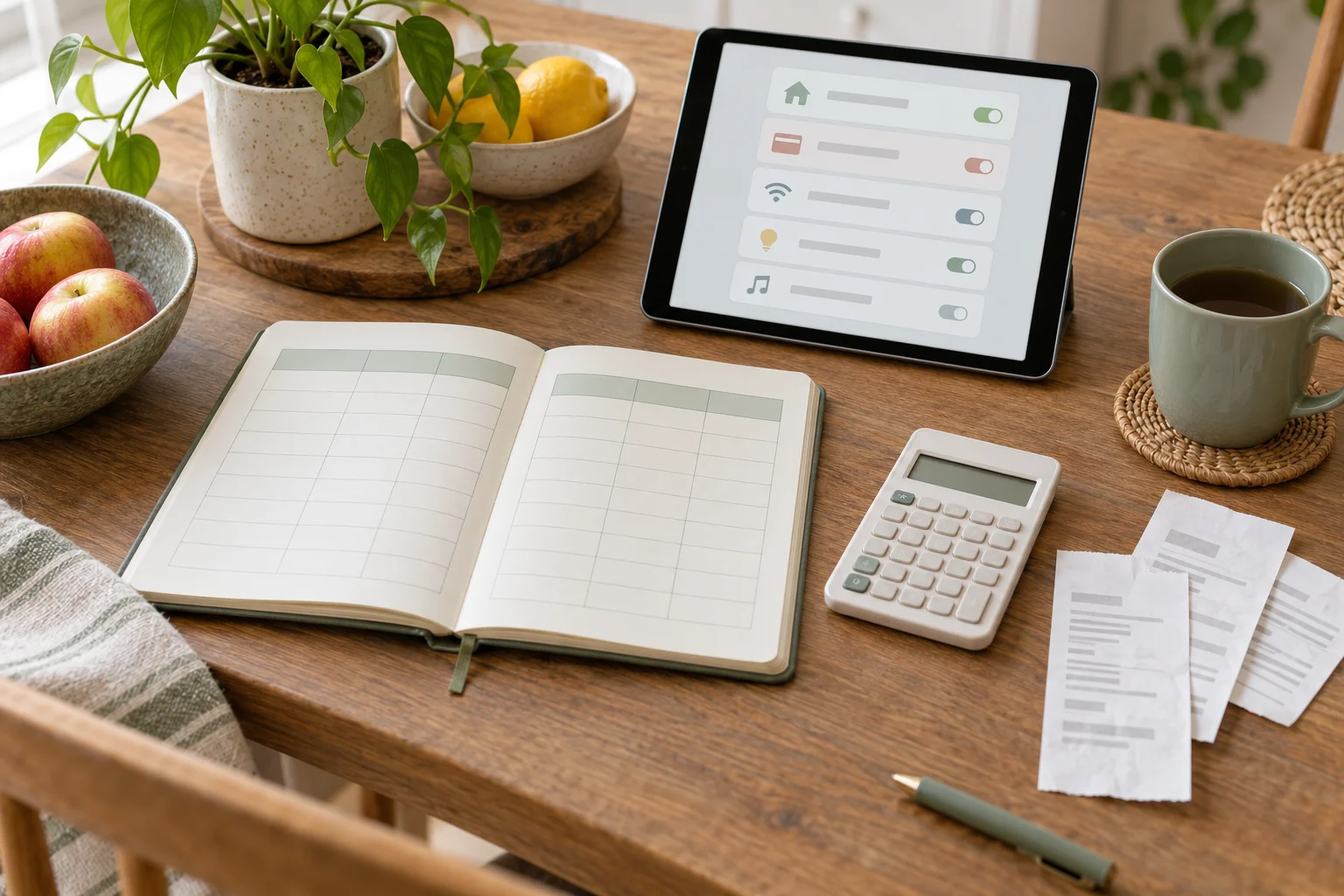
Why group household spending?
Many households have spending information spread across bank apps, card statements, receipts, payment notifications, and handwritten notes. Looking at each transaction separately can make the month feel more complicated than it is.
Grouping spending creates a clearer view. Instead of asking where every small amount went, you can ask broader questions:
- Which payments repeat each month?
- Which expenses are essential for the household routine?
- Which expenses change from month to month?
- Which records need a note because the purpose is unclear?
The purpose is not to judge every purchase. It is to make the next household decision easier. A useful record can be brief, consistent, and easy to update.
The four-part framework: prepare, sort, act, review
Use the same four stages each month. Keeping the stages separate prevents the routine from turning into an unplanned deep review.
1. Prepare
Collect the sources you already use for household spending records. Depending on your household, these may include a bank transaction list, card statement, payment notification, receipt folder, or shared expense note.
Choose one place for the monthly summary. It could be a spreadsheet, a notes app, or a paper sheet. The tool matters less than having a consistent location that household members can understand.
For the first session, use the most recent completed month. Do not delay the routine while trying to reconstruct older months.
2. Sort
Group transactions using categories that help you make decisions. A practical starting set is:
- Home and utilities: housing-related household bills and basic services.
- Food: groceries, meals, and other food-related spending.
- Transport: commuting, fuel, fares, parking, and similar costs.
- Health and care: health-related purchases and care expenses.
- Household and personal: home supplies, clothing, personal items, and routine purchases.
- Leisure and social: hobbies, entertainment, outings, and social occasions.
- Unclear or one-time: transactions that need a note before they can be grouped confidently.
You do not need a large number of categories. If two categories lead to the same decision, consider combining them. If a category contains several different decisions, consider separating it.
3. Act
After sorting, select one or two items that deserve attention. Examples include confirming an unfamiliar recurring payment, adding a note to a one-time expense, or deciding who will record a shared purchase.
An action should be specific enough to complete. “Control spending” is vague. “Check the three recurring payments listed in the monthly summary” is easier to follow.
4. Review
Finish by recording a short monthly note. Mention an unusual expense, a category that was difficult to classify, and the action to carry into the next month. This creates context without requiring a long diary.
A 15-minute household spending routine
The following schedule keeps the session focused. Adjust the timing if your household has more accounts or several people recording expenses.
| Time | Task | Output |
|---|---|---|
| Minutes 0–3 | Prepare recent records and open the monthly summary | One working list of transactions or totals |
| Minutes 3–8 | Sort spending into broad categories | Grouped spending records |
| Minutes 8–11 | Mark recurring, one-time, and unclear items | Short review list |
| Minutes 11–14 | Choose one or two follow-up actions | Specific next steps |
| Minute 15 | Write a short monthly note | Context for the next review |
If the records are incomplete, write down what is missing and continue with the information available. The aim of this routine is to create a workable summary, not to turn one month into a reconstruction project.
How to identify recurring payments
Recurring payments deserve a separate mark because they can continue without appearing in daily spending decisions. Look for similar descriptions, repeated dates, or regular amounts in your records.
Use a simple recurring-payment list:
| Payment or service | Typical timing | Record status | Next check |
|---|---|---|---|
| Example: household service | Monthly | Confirmed or unclear | Review description |
| Example: membership | Regular interval | Confirmed or unclear | Check whether it is still used |
Use the table as a record, not as a prompt to cancel a payment automatically. Before changing a payment, check the relevant account details, household needs, and any applicable service terms.
Use expense notes for context
A number alone may not explain why a transaction occurred. A short expense note can prevent confusion later. Useful notes answer one question: “What should we remember about this item?”
- Purpose: “Replacement household item.”
- Timing: “One-time purchase this month.”
- Shared responsibility: “Paid by one household member; discuss shared recording.”
- Classification: “Recorded under food because the receipt included mixed items.”
- Follow-up: “Confirm whether this payment repeats next month.”
Keep notes short. A few useful words are easier to maintain than a detailed explanation for every transaction.
A copyable monthly comparison table
Use this table to compare the current month with the previous month without creating a complex financial report.
| Category | Previous month | Current month | What changed? | Next action |
|---|---|---|---|---|
| Home and utilities | ||||
| Food | ||||
| Transport | ||||
| Health and care | ||||
| Household and personal | ||||
| Leisure and social | ||||
| Unclear or one-time |
Use the “What changed?” column for a short explanation rather than a judgment. For example, note a seasonal purchase, a family event, a replacement item, or an item that was recorded differently from the previous month.
Copyable 15-minute checklist
- Gather the household spending records for the completed month.
- Choose one place for the monthly summary.
- Group spending into a small set of useful categories.
- Mark recurring payments separately.
- Mark one-time or unclear expenses.
- Add short notes where the purpose may be forgotten.
- Compare the current summary with the previous month.
- Choose one or two specific follow-up actions.
- Write one sentence about what to remember next month.
Common problems and simpler alternatives
“Our records are incomplete.”
Start with the records that are available and label missing areas. A partial summary can still show which payments need clarification. Add a process improvement for the next month, such as saving receipts in one place or using one shared expense note.
“We disagree about categories.”
Choose a rule that can be applied consistently and write it beside the table. For mixed purchases, use the category that best supports the household decision, then add a brief note if needed. Consistency is more useful than debating every borderline item.
“The review takes too long.”
Reduce the number of categories and limit the session to one month. The first few reviews may require extra setup, but the ongoing routine can remain short when the same structure is reused.
“The list feels judgmental.”
Use neutral labels such as “one-time,” “recurring,” “unclear,” and “review.” The record is a coordination tool for the household, not a scorecard for individual purchases.
Conclusion
A practical household spending organization system does not need to track every detail. In a 15-minute monthly routine, prepare the records, sort them into useful groups, mark recurring and unclear items, choose a small action, and leave a note for the next review. The result is a clearer spending record that can support household conversations without creating a large administrative task.
FAQ
How many household spending categories should we use?
Begin with a small set that reflects the decisions your household makes. If a category is difficult to use consistently, rename it, combine it with a related category, or split it only when the distinction is useful.
Should every transaction have an expense note?
No. Add notes to items that are unusual, unclear, shared, or likely to be forgotten. Routine items can usually be grouped without a detailed explanation.
What should we do with a payment we do not recognize?
Mark it as unclear and check the relevant statement, account notification, or household member before classifying it. Avoid making a decision based only on a short transaction description.
Can this routine replace a full household budget?
This routine is for organizing spending records and preparing a monthly review. It does not replace any separate planning your household may use for saving, bills, or other financial decisions.