작성자: Kai Life Editorial Team
For a short seasonal tidy-up, use one visible staging area, sort items into four decisions, and give each group a specific storage destination. A practical 15-minute home organization routine is: prepare for 2 minutes, sort for 5 minutes, act for 6 minutes, and review for 2 minutes. The aim is not to reorganize the entire home; it is to create a clear next step for the seasonal items currently taking up space.
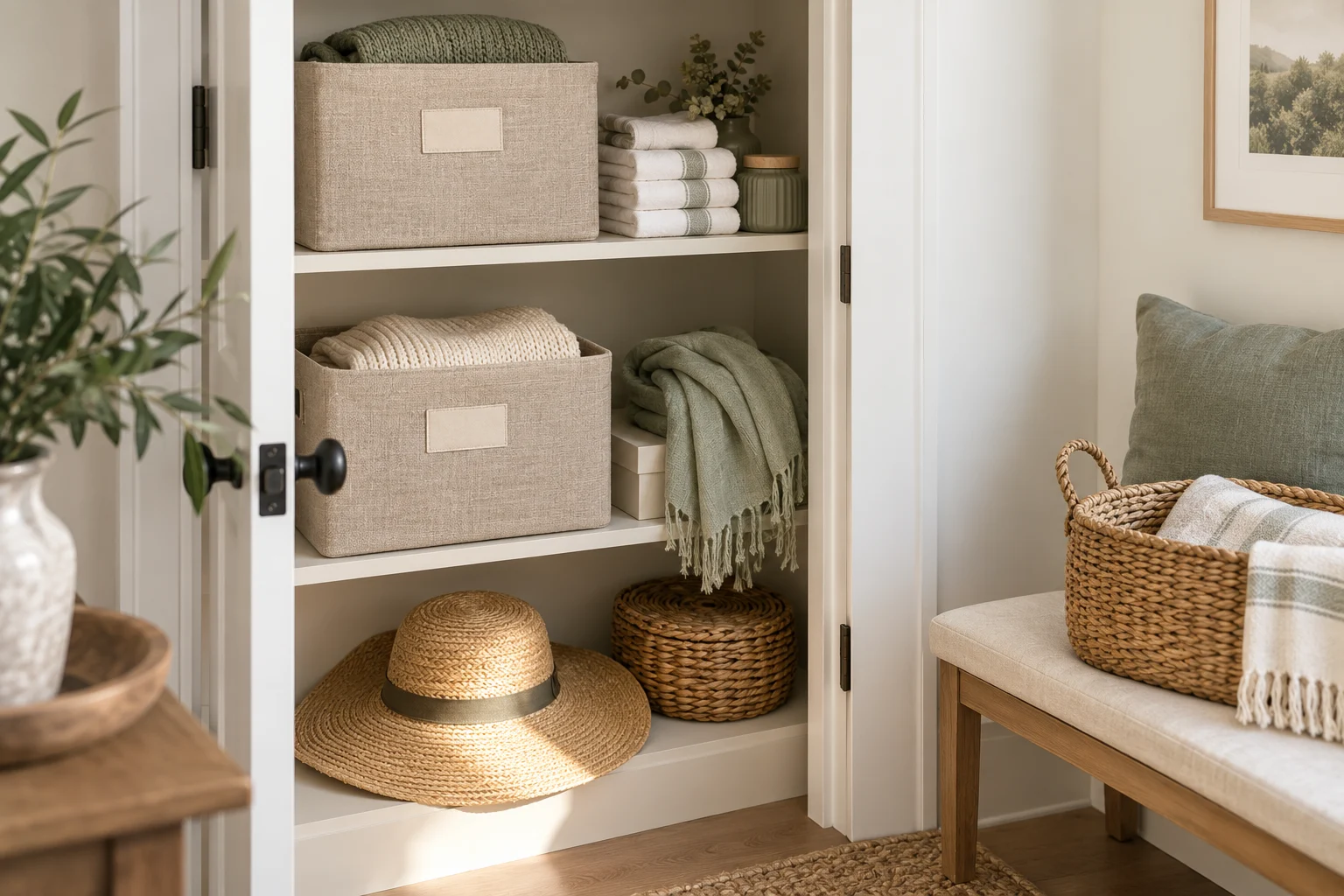
Why seasonal items create friction in small homes
Seasonal household items often move between useful and unused states. A fan, blanket, picnic set, humidifier, holiday decoration, or rain gear may be needed later, but it does not need to occupy the easiest-to-reach space today. When these items are stored without a shared rule, several small problems appear:
- Items from different seasons become mixed together.
- A container is opened repeatedly because its contents are unclear.
- Useful items are stored too far away, while rarely used items occupy convenient space.
- One item is kept in a different place from its accessories.
- A short tidy-up turns into a full-room project.
A calmer home flow comes from reducing decisions at the moment of putting something away. The system below focuses on four questions: What is this for? When will it be used? How often will it be accessed? Where can it return without blocking daily movement?
The four-part storage rule
1. Prepare: define the small project
Choose one seasonal category or one storage zone. Examples include cold-weather bedding, warm-weather accessories, outdoor meal items, or holiday decorations. Avoid combining several unrelated categories in the same 15-minute session.
Set out one temporary staging area, such as a clear section of the floor, a table corner, or an empty chair. Gather only what you need to move the items: a cloth if dust is visible, labels or a marker, and an empty bag or box for items that need a different decision. You do not need to buy new storage equipment before testing the system.
2. Sort: make four decisions
Handle each item once when possible and place it into one of these groups:
- Use soon: The item is likely to be needed in the next part of the season or within the next few weeks.
- Store away: The item is useful but not part of the current routine.
- Move elsewhere: The item belongs with another category, room, or household member.
- Review later: The item needs a separate decision because it is damaged, duplicated, incomplete, or no longer relevant.
The “review later” group prevents a storage session from becoming a difficult decluttering session. Put those items together and give them a visible note or a later review date. The purpose is to contain the uncertainty, not to hide it inside a box.
3. Act: match access to storage
Place “use soon” items where they can be reached without disturbing other stored items. Place “store away” items in a less convenient location, provided the area is dry, stable, and suitable for the item. Keep sets together when a part is difficult to replace or easy to lose.
For each container, use a label that answers a useful question. “Winter” may be too broad if the container holds several unrelated objects. “Winter bedding—guest room” or “Outdoor picnic items” gives a clearer retrieval cue. If you do not have labels, write the category on a piece of paper and place it where the contents can be seen.
4. Review: check the home flow
Stand back and look at the route you use most often. Check whether the stored items block a doorway, drawer, cleaning tool, laundry path, or frequently used shelf. Then ask whether the next person in the household could find the category without an explanation. If not, change the location or improve the label.
The 15-minute action plan
| Time | Action | Decision rule |
|---|---|---|
| 0–2 minutes | Prepare one category and one staging area. | Keep the project narrow enough to finish a visible part. |
| 2–7 minutes | Sort each item into use soon, store away, move elsewhere, or review later. | Do not solve every uncertain item during the sorting phase. |
| 7–13 minutes | Return items to destinations and group accessories. | Place frequent-use items closer to the point of use. |
| 13–15 minutes | Label, remove the staging area, and check the walking route. | Leave no temporary pile without a next action. |
Use a timer if it helps you stop at the planned point. When the timer ends, unfinished work can become the next session’s starting point. A short routine stays useful when it has a clear stopping boundary.
Storage rules that work in a one- or two-person home
Give each category a home
Choose one primary location for each seasonal category. The location can be a shelf, drawer, cabinet section, under-bed area, or another suitable storage zone. A primary home reduces the chance that similar items will be distributed across several places.
Store by retrieval effort, not only by size
A small item may deserve an easy-to-reach location if it is used often. A large item may be acceptable in a harder-to-reach location if it is used briefly during one part of the year. Consider both physical size and retrieval frequency before assigning a space.
Keep components with the main item
Place cables, covers, spare parts, attachments, and related instructions with the item they support when practical. If a component needs a separate location, add a note to the main container. This reduces the chance of finding the main item but not the part needed to use it.
Leave a little decision space
Do not fill a storage area so tightly that returning one item requires removing several others. Some open space makes future seasonal changes easier and provides room for items that genuinely belong in the category.
Use visible cues for shared spaces
In a two-person home, a clear label or category name can be more useful than relying on memory. Use familiar words and avoid labels that describe the storage container rather than its contents. “Rainy-day entry items” communicates more than “blue box.”
Copyable seasonal storage checklist
Copy this checklist into a note or print it for the next short tidy-up:
- [ ] Choose one seasonal category.
- [ ] Select one staging area.
- [ ] Gather a marker, label, cloth, and review bag or box.
- [ ] Set a 15-minute boundary.
- [ ] Sort items into use soon, store away, move elsewhere, or review later.
- [ ] Keep important accessories with the main item.
- [ ] Move frequent-use items closer to their point of use.
- [ ] Place stored items in a dry, stable, suitable location.
- [ ] Label the container or shelf with a clear category name.
- [ ] Give review-later items a separate follow-up note.
- [ ] Remove the staging area.
- [ ] Check that doors, drawers, walkways, and daily-use surfaces remain clear.
What to do when the routine does not fit
Some items need special handling. Fragile objects may need protective packing. Fabrics may need to be clean and fully dry before storage. Items affected by moisture, heat, weight, or pests should be placed only in a location suitable for their material. If you are unsure whether a location is appropriate, pause the storage decision and check the item’s care guidance.
If the category cannot be sorted in 15 minutes, reduce the scope. Work on one shelf, one drawer, or one type of item instead of extending the session indefinitely. If the same category repeatedly creates confusion, the issue may be the storage rule rather than the amount of storage. Consider separating items by point of use or by season instead of adding another mixed container.
FAQ
Should I buy storage containers first?
Not necessarily. Sort the items and test a destination with the storage already available. This reveals the category’s actual shape and access needs before you choose any additional container.
What if I cannot decide whether to keep an item?
Place it in the review-later group rather than making a rushed decision. Keep that group separate from active seasonal storage and record the follow-up action. A contained delay is easier to manage than an unclear box.
Where should items used every season go?
Keep them in a location that is easy to reach during the relevant period. If the item is used frequently, point-of-use storage may be more useful than a distant storage area, even when the item is seasonal.
How often should I repeat the routine?
Repeat it when the season changes, when a storage zone becomes difficult to use, or when a category gains several new items. The routine can also be used after returning from a trip or completing a temporary household project.
Conclusion
A practical home organization system for seasonal items does not need a large reset. Start with one category, sort by the next useful decision, return items to a clear home, and review the walking route before stopping. The four-part sequence—prepare, sort, act, and review—keeps a 15-minute tidy-up focused while creating storage rules that can be repeated across the home.