Tag: lang-en

English content

  • LOUIS VUITTON Soft Polochon PM: Size, Storage and Styling

    LOUIS VUITTON Soft Polochon PM in dark blue Damier Heritage canvas with leather trimming

    LOUIS VUITTON Soft Polochon PM combines a dark blue Damier Heritage canvas exterior with a compact cylindrical shape. To assess whether it fits your routine, look at the listed dimensions, opening and documented storage features before considering outfit coordination. This guide is not a hands-on capacity or wear test.

    Its visual identity is rooted in a modern interpretation of the House’s emblematic pattern. Pharrell Williams’s take on the motif is influenced by the original rendering created by Georges Vuitton in 1888, including the historical “Marque L.Vuitton Déposée” signature. This connection between archival reference and contemporary styling makes the bag especially suited to wardrobes that value recognisable design without relying on excessive ornament.

    With a width of 26 cm, height of 14 cm, and depth of 14 cm, the proportions sit comfortably between a small shoulder bag and a compact messenger. A zip closure helps keep the contents enclosed, while the inside flat pocket provides a dedicated place for smaller essentials. The removable name tag allows the exterior to remain streamlined or to carry an additional accent, depending on the look.

    Check the packing layout, not just the exterior size

    The product information in this guide lists 26 cm width, 14 cm height and 14 cm depth. Reconfirm the current measurements on the product page. A cylindrical outline is not equivalent to a rectangular box with those measurements, and neither tells you the exact usable interior space.

    1. List the items you carry on an ordinary outing rather than starting with everything you might carry.
    2. Compare the largest item’s dimensions with the documented bag measurements and opening information.
    3. Look for the listed inside flat pocket and zip closure in the product information. Do not assume extra dividers or compartments.
    4. If fit is essential, ask the seller about the particular item rather than treating an exterior measurement as a fit guarantee.

    Two styling directions to try with your own clothes

    Direction Suggested starting point What to compare
    Quiet weekday outfit Navy or charcoal separates with a plain top Whether the pattern adds the amount of contrast you want without competing accessories.
    Relaxed city outfit Denim, a simple knit or shirt and restrained footwear How the cylindrical shape sits against the outfit’s lines in the carry style shown by the seller.

    These are styling proposals, not evidence of comfort, suitability for travel conditions or compatibility with a particular device.

    Design details that shape its everyday character

    The appeal of LOUIS VUITTON Soft Polochon PM lies in the balance between graphic pattern, tactile contrast, and practical organisation. Each listed detail contributes to a bag that can move easily from relaxed daytime dressing to more considered city looks.

    • Damier Heritage canvas: The dark blue Damier fabric creates a strong visual foundation, drawing attention through pattern and tone rather than bright colour.
    • Distinctive construction: Cowhide leather trimming frames the bag and introduces a contrasting material against the canvas. The lining is fabric, with silvery metal elements completing the hardware palette.
    • Compact proportions: Measuring 26 cm by 14 cm by 14 cm, the PM format offers a neat silhouette that is easy to coordinate with layered outfits and shorter outerwear.
    • Zip closure: The main opening closes securely with a zip, giving the bag a clean appearance when worn across the body or carried by hand.
    • Inside flat pocket: A flat interior pocket helps separate smaller belongings from the main compartment, making everyday organisation more straightforward.
    • Removable name tag: Keep the tag attached for a more distinctive finish, or remove it when a quieter, more minimal presentation suits the outfit.

    The combination of dark blue, silvery metal, and leather trimming also makes coordination simple. Rather than competing with colour-heavy clothing, the bag can anchor a neutral palette and add pattern to otherwise understated styling.

    How to style and use it across the week

    The compact format of LOUIS VUITTON Soft Polochon PM is particularly effective when the occasion calls for essentials without visual bulk. Its proportions work naturally with modern everyday outfits, while the Damier Heritage canvas adds enough distinction to make the accessory feel intentional.

    1. Elevated daily dressing: Pair the dark blue bag with a crisp shirt, fine knitwear, straight trousers, or clean denim. The patterned canvas can serve as the focal point of a restrained outfit, especially when the rest of the palette stays within navy, white, grey, black, or soft beige.
    2. Relaxed weekend looks: Wear it with a simple T-shirt, overshirt, and casual trousers for a balanced contrast between easy clothing and a more refined accessory. Keeping the removable name tag attached can reinforce the bag’s graphic character.
    3. Layered seasonal styling: The compact dimensions sit neatly against coats, jackets, or tailored overshirts without overwhelming the silhouette. For a quieter appearance, remove the tag and let the dark blue canvas coordinate with the outer layer.
    4. Smart casual evenings: The zip closure and silvery metal details lend a polished finish to a monochrome look. A dark blazer or tailored jacket can highlight the bag’s structured shape without making the overall styling feel formal.

    For carrying, the bag can be considered alongside the rest of the outfit’s proportions. Streamlined clothing supports its compact form, while relaxed silhouettes create a more casual contrast. When coordinating accessories, silvery metal details pair naturally with cool-toned jewellery or understated hardware. Leather footwear in a complementary dark shade can connect the trimming to the rest of the look without matching every element exactly.

    Because the product page specifies that only items shown in the product photos and expressly listed on the page are included, review the presentation carefully when planning how the bag will be used or styled.

    What to consider before choosing this piece

    When selecting LOUIS VUITTON Soft Polochon PM, begin with the intended role in your wardrobe. This is a compact format, so it is best approached as a focused everyday or occasion bag rather than a large-capacity carryall. Consider the essentials you normally take with you and whether the listed 26 cm width, 14 cm height, and 14 cm depth suit that routine.

    Next, assess the visual balance. Damier Heritage canvas is central to the design, and the dark blue colour offers versatility while retaining a clear pattern identity. It can work well for someone who prefers a recognisable textile motif but wants an alternative to an all-black accessory. The cowhide leather trimming adds definition, while the fabric lining and silvery metal details maintain a coordinated finish.

    Organisation is another useful point of comparison. The zip closure provides a defined opening, and the inside flat pocket is useful for separating smaller items. If quick access or a highly open interior is a priority, compare those needs with the listed construction before purchase. The removable name tag also gives a small styling choice: attached for added character, removed for a more pared-back appearance.

    Finally, review the product information and images in detail. The listed country of manufacture is France, and the product code is LVUPHEV6BLUZZZZZ00. Packaging and accessories are limited to items shown in the product photos and expressly listed on the page; original brand packaging is not guaranteed. These points are important when evaluating the complete purchase as well as the bag itself.

    Frequently asked questions

    What is the size of LOUIS VUITTON Soft Polochon PM?

    The listed measurements are 26 cm wide, 14 cm high, and 14 cm deep, equivalent to approximately 10.24, 5.51, and 5.51 inches.

    What colour is the bag?

    The specified colour is dark blue, presented in Damier Heritage canvas with cowhide leather trimming.

    What storage features are included?

    The bag has a zip closure and an inside flat pocket. It also includes a removable name tag as part of the listed design details.

    What materials are specified?

    The product data lists Damier fabric, cowhide leather trimming, a fabric lining, and silvery metal elements.

    Is original brand packaging included?

    Original brand packaging is not guaranteed. Only items shown in the product photos and expressly listed on the product page are included.

    Where is it manufactured?

    The listed country of manufacture is France.

    Please verify the current product details, measurements, included items, and purchase information on the product page before purchase.

    View LOUIS VUITTON Soft Polochon PM at THANKS KAI to explore the current product information and presentation.

    Product: LOUIS VUITTON Soft Polochon PM

  • Small Home Organization: Store Everyday Items Where You Use Them

    Small Home Organization: Store Everyday Items Where You Use Them

    By Kai Life Editorial Team

    For a small home, begin with one repeated activity and keep the items it needs near the point of use. Then test whether those items are just as easy to put back. This approach helps you evaluate a storage layout before buying organisers or rearranging an entire room.

    A Four-Step Home Organization Rule for Shorter Paths — topic illustration

    Worked example: an entryway without a return point

    Imagine that a bag lands on a chair, keys travel between two surfaces and outgoing items are forgotten in another room. The layout may look tidy after a clean-up but still provide no obvious return point. The example below is fictional and does not claim a measured reduction in time or walking distance.

    Item First placement idea Test during normal use
    Keys One clearly designated place near the normal arrival point Can each person who uses it find and return the keys consistently?
    Everyday bag An existing suitable surface or storage spot Does putting it away keep the route and other necessary access clear?
    Items leaving the home A small, defined departure area Are unrelated items accumulating there, or does it still mean “take this out”?

    Run the take-out and put-back test

    1. Do the ordinary activity once without first staging the space for the test.
    2. Notice where an item is left when it is no longer needed.
    3. If the planned return point is repeatedly bypassed, reconsider its position, accessibility or capacity.
    4. Change one thing and observe again rather than adding several new containers at once.

    Before buying storage: measure the available space, identify the specific item group, and check that the proposed placement does not obstruct a walkway, exit or necessary access. An attractive container cannot resolve an unclear purpose by itself.

    Why placement affects home flow

    A room can look tidy and still create unnecessary movement. For example, mugs may be stored far from the kettle, cleaning cloths may be kept in another room, or everyday bags may have no clear landing spot near the entrance. These small gaps make ordinary tasks include extra walks, temporary piles, or items left in convenient but unsuitable places.

    The aim is not to make every item equally accessible. A more useful approach is to match storage distance with how often an item is used and where the action happens. Items used several times a day deserve a short return path. Items used occasionally can occupy less convenient storage, provided that their location remains clear and safe.

    Think of each area as having three practical zones:

    • Action zone: the surface or location where an activity takes place.
    • Near zone: storage within a short reach or a few steps of that activity.
    • Reserve zone: storage for occasional, seasonal, spare, or backup items.

    This zoning method supports home organization while leaving room for different layouts and household habits. It also avoids assuming that one storage arrangement works for every home.

    Step 1: Prepare by observing one short route

    Choose one repeated activity rather than trying to reorganize the entire home. Suitable examples include making a drink, leaving for work, preparing a simple meal, doing laundry, or cleaning the bathroom. Observe the route from beginning to end.

    Write down the points where you stop, turn back, open several cabinets, or place an item temporarily. The goal is not to judge the route. It is to identify where the current storage rule does not match the activity.

    Use these preparation questions:

    • Where does the activity begin?
    • Which items are handled during the activity?
    • Where is each item currently stored?
    • Which item is commonly left out after use?
    • Is the problem distance, limited capacity, unclear ownership, or difficult access?

    Limit the first review to one cabinet, shelf, drawer, or landing area. A narrow scope makes the action easier to complete and gives you a clear result to review.

    Step 2: Sort items by use and return difficulty

    Take out only the items connected with the selected activity. Sort them into four groups. These groups are storage decisions, not permanent judgments about whether an item should remain in the home.

    Group Placement idea Question to ask
    Frequent use Keep in the action zone or near zone Is the item used during most repetitions of the activity?
    Occasional use Keep in a reserve zone Would a short delay be acceptable when it is needed?
    Backup or duplicate Store together and label the location Does the duplicate need to be available in the action zone?
    Unresolved Set aside for later review Is the item’s use or storage purpose clear?

    Next, consider return difficulty. An item may be physically close but still inconvenient if it requires stacking, moving another object, opening a tight container, or reaching an unsafe height. Storage rules work better when both access and return are simple.

    For shared homes, add an ownership check. If two people use the same item differently, choose a location that both can identify and reach. If an item belongs mainly to one person, that person’s routine can guide the placement, while shared access and safety remain relevant.

    Step 3: Act with a shorter-path placement rule

    Now place the highest-frequency items closest to the action zone. Move occasional items outward, upward, or into a clearly marked reserve location. Keep related items together when separating them would create additional searching or walking.

    Use this placement rule:

    1. Place the item where the activity begins or happens if it is used repeatedly during that activity.
    2. Place supporting items in the nearest practical storage location.
    3. Move backups and seasonal items away from the main working area.
    4. Give unresolved items a temporary holding location instead of returning them randomly.
    5. Test whether the item can be taken out and put back without shifting several other items.

    Do not treat every empty space as storage capacity. Keep walkways, exits, work surfaces, vents, heat sources, and frequently opened doors usable. Heavy or awkward items may need a lower, more stable location. Household safety and accessibility take priority over a shorter route.

    When no location seems suitable, the issue may be capacity rather than placement. In that case, reduce duplicates, group similar items, or postpone a purchase until the actual gap is clear. New containers can support a storage rule, but they do not replace one.

    Step 4: Review the route after one normal use

    Use the adjusted area once under ordinary conditions. Notice whether you still walk back for an item, leave something on a nearby surface, or hesitate because the storage location is unclear.

    Review the result with three questions:

    • Path: Did the activity require fewer unnecessary trips?
    • Return: Could each item go back without extra rearranging?
    • Clarity: Could another household member identify the intended location?

    If one answer is no, make one small change rather than redesigning the entire area. Move the item closer, separate frequent and occasional items, or create a clearer return point. A storage rule should support real behavior, including rushed moments and incomplete tidying.

    A focused 15-minute tidy-up plan

    Use this sequence when you want a short, contained reset.

    1. Minutes 1–3: Choose one activity and observe its route.
    2. Minutes 4–6: Gather the connected items and remove obvious unrelated objects.
    3. Minutes 7–10: Sort items into frequent, occasional, backup, and unresolved groups.
    4. Minutes 11–13: Place frequent items near the action zone and group the remaining items.
    5. Minutes 14–15: Test one normal use and record the next adjustment.

    Stopping after one area is acceptable. The purpose of a short tidy-up routine is to create a manageable decision, not to turn a small task into a full-home project.

    Copyable home organization checklist

    Check Task
    □ I selected one repeated activity.
    □ I identified the starting point and action zone.
    □ I gathered only the items connected to that activity.
    □ I sorted items by frequency, backup status, and uncertainty.
    □ I placed frequent-use items in the nearest practical location.
    □ I moved occasional and seasonal items to a reserve zone.
    □ I kept walkways, exits, and work surfaces usable.
    □ I tested taking items out and returning them.
    □ I noted one adjustment for the next review.

    Conclusion: organize around repeated movement

    Effective home organization can begin with one question: “Where does this item need to be when this activity happens?” Place frequent-use items near their action zone, keep occasional items in a reserve zone, and make returning items as clear as taking them out. The prepare, sort, act, and review framework turns that idea into a small experiment that can fit into a 15-minute tidy-up routine.

    FAQ

    Should every item be stored close to where it is used?

    No. Close storage is most useful for frequently repeated activities. Occasional, seasonal, spare, or rarely used items can be placed farther away when the location remains identifiable and practical.

    What if two activities need the same item?

    Compare how often each activity uses it and how difficult it is to return. A shared location near the more frequent activity may be suitable, or a neutral location may work better when both routines are similar.

    What if the home still feels crowded after sorting?

    The issue may be capacity rather than path length. Review duplicates, unclear categories, and items without a defined storage purpose. Consider additional storage only after identifying the specific gap it would address.

    How often should the arrangement be reviewed?

    Review it after a few normal uses or whenever the activity, household, or season changes. Small adjustments can be more useful than a large reset when the problem is limited to one route.


  • A Refined Guide to Choosing a Versatile Luxury Cap

    LOUIS VUITTON LV City Cap in black with embroidered LV Circle and Louis Vuitton signature

    LOUIS VUITTON LV City Cap brings an easy, sporty finish to everyday dressing while retaining a distinctly considered presence. In black, it offers the kind of visual flexibility that allows a cap to move naturally between relaxed tailoring, denim-led outfits, and understated weekend layers. The design is defined by two embroidered signatures: an LV Circle at the centre and a Louis Vuitton signature at the back. Together, they create a balanced arrangement of branding, with a clear focal point from the front and a quieter House detail when viewed from behind.

    Made from 100% cotton, this style is presented as a comfortable accessory for casual ensembles. Its adjustable strap is designed to support a comfortable fit, making selection less dependent on a fixed size and more responsive to personal preference. The proportions are listed as 27 cm in width, 13 cm in height, and 15 cm in depth. As a wardrobe accent, it is best understood not as a statement reserved for special occasions, but as a polished finishing piece for daily looks that benefit from structure and a subtle luxury reference.

    Design Details That Shape the Look

    The appeal of LOUIS VUITTON LV City Cap lies in its restrained composition. The black colour creates a versatile foundation, while the embroidered details add definition without requiring additional decoration. The central LV Circle embroidery gives the front a recognisable point of interest, making the cap effective when worn with simple clothing and minimal accessories. At the back, the embroidered Louis Vuitton signature introduces a second viewpoint and reinforces the House identity with a more linear detail.

    • Colour: Black, a straightforward choice for coordinating with neutral, denim, and tonal wardrobes.
    • Material: 100% cotton, specified as part of the product details.
    • Fit adjustment: An adjustable strap allows the wearer to refine the fit for personal comfort.
    • Branding: Embroidered LV Circle at the front and embroidered Louis Vuitton signature at the back.
    • Measurements: Width 27 cm, height 13 cm, and depth 15 cm.
    • Origin and presentation: Manufactured in Italy and delivered in 24S packaging, according to the supplied product information.

    These details make the cap particularly useful when an outfit needs a final element that feels intentional but not overly formal. The embroidery also gives it a more tactile visual character than a completely plain cap, while the black cotton construction keeps the overall impression grounded and easy to style.

    How to Style It Across Everyday Dressing

    For a clean daily look, pair LOUIS VUITTON LV City Cap with a white or grey top, straight-leg denim, and simple trainers. This combination lets the front embroidery act as the principal accent while maintaining an uncomplicated silhouette. A black or charcoal outer layer can create a tonal effect, allowing the cap to blend into the outfit rather than stand apart from it.

    For a more polished casual approach, use the cap to soften a structured jacket or tailored trousers. Keep the rest of the accessories controlled so that the embroidered LV Circle remains the clearest visual detail. The contrast between tailoring and a sporty cap can make an outfit feel contemporary without becoming complicated. Black footwear or a black belt can help connect the cap to the wider look.

    On relaxed weekends, wear it with a sweatshirt, lightweight knitwear, or a casual shirt layered over a simple base. The adjustable strap is useful in this context because it allows the fit to be refined according to how the cap is worn. A closer fit can look more streamlined, while a more relaxed adjustment can complement loose, layered clothing.

    The back embroidery also makes the cap worthwhile in outfits viewed from multiple angles. Consider it with an open overshirt, a bomber-style layer, or a simple coat where the rear of the accessory remains visible. For travel or day-to-day errands, its compact accessory profile can provide an immediate sense of finish without adding visual weight to a practical outfit.

    When coordinating jewellery or other branded pieces, choose restraint. One or two considered details will usually create a more refined result than a heavily layered selection of logos. The cap already contains a clear House signature, so clean colour relationships and thoughtful proportions are enough to complete the styling.

    What to Consider Before Choosing

    Begin with your wardrobe rather than the logo. A black cap is at its most useful when it can connect with the colours you already wear. If your everyday rotation includes denim, white, grey, black, navy, or other understated tones, this colourway should coordinate naturally. It can also provide a grounding contrast against lighter or more expressive casual clothing.

    Next, consider the role you want the accessory to play. The embroidered LV Circle gives the front a defined focal point, so it suits outfits that need a clear finishing detail. If you prefer accessories that remain almost invisible, a plain cap may be a better aesthetic match. If you want a sporty piece with a recognisable House touch, this design offers a more distinctive direction.

    Fit is another practical consideration. The product includes an adjustable strap, but individual preferences still vary. Review the listed measurements and use the available size guide before purchase, particularly if you have a specific preference for a close or relaxed fit. Measurements are given as width 27 cm, height 13 cm, and depth 15 cm.

    For care, follow the care information supplied with the product and avoid assuming that cotton accessories can be treated identically. Keep the cap protected from unnecessary crushing, and store it in a way that helps preserve its shape. When coordinating it with clothing, consider the embroidery as a detail to keep visible rather than covering it with heavy layers or placing competing graphics directly beside it.

    Finally, note the supplied product information carefully: the material is listed as 100% cotton, the colour as BLACK, the country of manufacture as Italy, and the item as delivered in 24S packaging. Confirm all current details, including measurements and product presentation, on the product page before completing a purchase.

    Frequently Asked Questions

    What material is LOUIS VUITTON LV City Cap made from?
    The supplied product information lists the material as 100% cotton.

    How is the cap adjusted?
    It includes an adjustable strap intended to support a comfortable fit.

    What colour is available in the supplied details?
    The listed colour is BLACK.

    Where is it manufactured?
    The product information states that it is manufactured in Italy.

    What are the listed item measurements?
    The measurements are width 27 cm, height 13 cm, and depth 15 cm.

    Which details are embroidered?
    An LV Circle is embroidered at the centre, and a Louis Vuitton signature is embroidered at the back.

    Please verify current product details, measurements, packaging information, and purchase information on the product page before purchase.

    View LOUIS VUITTON LV City Cap at THANKS KAI to consider its styling potential and current product details.

    Product: LOUIS VUITTON LV City Cap

  • A Refined Pendant for Everyday and Party Styling

    YF8439 pendant necklace with geometric round CZ zircon detail in a gold-plated stainless steel design

    YF8439 [Product Demo Video] Waterproof 18K Gold-Plated Stainless Steel Spring Snake Chain Large CZ Zircon Pendant Necklace for Women brings a polished pendant silhouette to the daily jewellery wardrobe. Presented by YISS under model number yf8439, it combines a stainless steel construction with 18K gold plating, a geometric design language, and a round zircon main stone set through micro-inlay technology.

    The necklace is offered in Silver and Gold versions, giving the same pendant concept two distinct styling directions. Gold can create a warm, luminous finish with neutral tailoring, cream knitwear, or evening textures, while Silver offers a cooler, cleaner counterpoint to black, grey, denim, and crisp white. As a pendant necklace intended for women and associated with party occasions, it can move comfortably between a carefully assembled daily look and a more considered after-dark outfit.

    Its spring snake chain character suggests a smooth, fluid visual line, while the large CZ zircon pendant provides a clear focal point at the neckline. Rather than relying on elaborate layering, this design is suited to outfits where one defined accessory can complete the composition. It is a confident choice for OOTD styling, occasion dressing, and simple looks that benefit from a concentrated touch of shine.

    Design Details That Shape the Look

    This necklace is best understood through the relationship between its chain, pendant, finish, and stone. Each element contributes to a style that is noticeable without requiring a crowded jewellery arrangement.

    • Stainless steel construction: The listed main material and material type are both stainless steel, creating the foundation for the necklace’s structured yet wearable presentation.
    • 18K gold-plated finish: The Gold version adds a warm metallic effect, while the availability of a Silver version provides a more neutral alternative. Select according to the tones already present in your wardrobe.
    • Spring snake chain character: The product name identifies a spring snake chain, while the supplied specification lists a link chain type. Together, these details describe a chain-led design with a sleek, continuous visual presence.
    • Large CZ zircon pendant: The main stone is listed as zircon, with a round stone shape. Its scale gives the neckline a defined centre and helps the necklace read as a complete styling feature.
    • Geometric direction: The shape pattern is geometric, bringing a clean, modern note to the otherwise classic pendant format.
    • Micro-inlay technology: The listed inlay technology supports the pendant’s detailed stone presentation without changing its straightforward, easy-to-style silhouette.
    • Trendy, occasion-ready appeal: The style is described as trendy, and both the occasion and application are listed as party, making it suitable for looks that call for a little more visual emphasis.

    The result is a piece that can be styled as a single statement at the neckline or coordinated with restrained accessories. Its strongest effect comes from allowing the pendant to remain visible rather than competing with high collars, dense prints, or heavily layered chains.

    How to Style It Across the Wardrobe

    For an elevated daily look: Pair the Gold version with a plain blouse, fine knit, or simple crew-neck top in ivory, beige, chocolate, or soft black. Keep earrings minimal so the pendant remains the visual anchor. With denim and a tailored jacket, the necklace adds a refined finish without requiring a fully formal outfit.

    For a clean monochrome outfit: Silver works particularly well with black, white, charcoal, and cool blue. Wear it over a smooth neckline or against a simple top where the geometric pendant can be seen clearly. A monochrome base lets the zircon detail provide the contrast.

    For party dressing: The necklace’s listed party application makes it a natural companion to a dress, satin-look separates, or a sharply cut evening top. Choose one main texture or point of shine elsewhere in the outfit, then allow the pendant to complete the look rather than stacking several competing statement pieces.

    For an OOTD photograph: Position the neckline so the chain and pendant are both visible. Solid colours generally offer a clearer background than busy patterns, while an open collar or uncomplicated round neckline can frame the pendant effectively. Gold brings warmth to softly lit styling; Silver gives a brighter, more graphic impression.

    For selective layering: If you prefer a layered look, use a shorter, delicate chain with a deliberately quiet finish and leave enough visual space for the large pendant. Avoid adding another prominent geometric or stone-set necklace, as similar focal points can make the neckline feel congested.

    When coordinating the piece with other jewellery, repeat either the metal direction or the design mood. Gold earrings can echo the Gold version, while simple silver-toned studs or a slim bracelet can support the Silver version. The goal is cohesion rather than exact matching.

    Choosing the Right Version and Styling Approach

    Begin with colour harmony. Choose Gold if your wardrobe leans toward warm neutrals, camel, cream, brown, olive, or rich evening tones. Choose Silver if you often wear cool neutrals, denim, black, white, grey, or a more minimalist palette. If your wardrobe is varied, consider which metal you reach for most often in existing accessories; the more familiar choice is likely to integrate more naturally into daily outfits.

    Next, consider visual scale. The product is described as having a large CZ zircon pendant, so it is intended to be seen. It will suit shoppers looking for a defined neckline feature rather than an almost invisible accent. Check the product page for current imagery and any available selection information before deciding how the pendant’s scale will work with your preferred necklines.

    Think about occasion as well as frequency. Although the source collection is titled “Daily 18K Necklaces for Women,” the supplied specifications also identify party as the occasion and application. This combination suggests a versatile styling role: wear it with uncomplicated everyday outfits when you want a polished focal point, then bring it into party dressing when a brighter pendant finish feels appropriate.

    For coordination, keep the rest of the outfit intentional. A clean neckline, controlled pattern, and one supporting accessory usually allow the geometric design and round zircon stone to read most clearly. If your outfit already includes strong embellishment, use the necklace as the sole jewellery statement and simplify other details.

    Before purchase, review the product page for the current Silver or Gold option, product presentation, and purchase information. The title describes the necklace as waterproof, but readers should still consult the current product-page guidance for suitable use and care rather than relying on a general assumption. Handle and store the necklace according to the information provided with the product, and keep its finish and presentation in mind when planning long-term wear.

    Frequently Asked Questions

    What is the main material?
    The listed main material and material type are stainless steel.

    What finish does the necklace have?
    It is listed as 18K gold plated, and the product is presented in Gold and Silver versions.

    What is the main stone?
    The main stone is listed as zircon, with a round stone shape.

    Is this a pendant necklace?
    Yes. The supplied specifications classify it as a pendant necklace.

    What kind of styling suits it?
    It can be used as a defined focal point for daily outfits, OOTD looks, and party dressing, especially when paired with a clear neckline and restrained supporting accessories.

    Where should I confirm current purchase details?
    Review the product page for the latest option information, presentation, and purchase details before ordering.

    Please verify current product details, available options, product-page guidance, and purchase information on the product page before purchase.

    View YF8439 [Product Demo Video] Waterproof 18K Gold-Plated Stainless Steel Spring Snake Chain Large CZ Zircon Pendant Necklace for Women at THANKS KAI.

    Product: YF8439 [Product Demo Video] Waterproof 18K Gold-Plated Stainless Steel Spring Snake Chain Large CZ Zircon Pendant Necklace for Women

  • A Refined Four-Leaf Clover Necklace for Everyday Styling

    Mini 14K gold four-leaf clover flower pendant necklace shown in a selected colour option

    Wholesale 14K Gold Jewelry Korean Mini Exquisite Four-Leaf Clover Charm 14K Gold Pendant Necklace for Women brings a small, expressive botanical motif to a polished everyday jewellery wardrobe. Designed as a pendant necklace with a strand chain, it combines a flower-shaped form, 14K gold, and micro-insert detailing in a compact silhouette that is easy to coordinate across changing looks.

    The design is offered in White, Red, Pink, Green, Blue, and Black. That colour selection makes the necklace more than a single styling statement: it can work as a quiet neutral accent, a soft feminine detail, or a vivid focal point depending on the shade selected. The four-leaf clover-inspired charm also gives the piece a thoughtful visual character suited to gifting, celebrations, and personal daily wear.

    Listed by Yuzhifei under model number NL14, this necklace is identified as a women’s and children’s pendant necklace. Its styling appeal lies in its balance: the flower shape feels recognisable yet versatile, while the fine scale supports layering, simple necklines, and restrained occasion dressing.

    Design Details That Shape the Look

    Four-leaf clover-inspired flower charm: The central motif introduces a naturally optimistic, decorative note without requiring an elaborate outfit. Its floral geometry can read as charming and delicate when worn alone, or as a colourful punctuation mark within a layered jewellery arrangement.

    Six colour directions: White offers the most understated approach and pairs easily with a broad wardrobe. Red creates a more noticeable accent, while Pink brings a gentle tonal touch. Green and Blue add a cooler, more distinctive colour note, and Black provides the strongest contrast for monochrome or evening-inspired styling.

    14K gold construction: The product details identify the main jewellery material as gold, with 14K gold purity and 14K solid gold plating listed. These details give the necklace a warm, refined foundation that can sit comfortably within a coordinated gold jewellery collection.

    Micro-insert technique: The listed inlay technology is micro insert. This detail supports the charm’s miniature, decorative presentation and helps explain why the necklace reads as an intricate accent rather than a large statement piece.

    Convertible styling personality: Although the piece is described as trendy, its compact pendant format keeps it adaptable. Wear it as a single point of interest with a crew neck, place it over a clean blouse, or combine it with other fine necklaces when you want a more layered finish.

    • Jewellery type: pendant necklace
    • Chain type: strand
    • Shape: flower
    • Listed occasions: gift, party, wedding, and anniversary
    • Brand: yuzhifei

    How to Style It Across the Day

    For a considered daily look: Choose White or Black with a plain knit, crisp shirt, or simple T-shirt. The small clover charm adds definition around the neckline while preserving a clean overall impression. Keep earrings minimal if you want the pendant to remain the visual centre.

    For colour-led outfits: Treat the pendant as a deliberate colour note rather than trying to match every detail. Green can complement natural, earthy styling; Blue can sharpen white, denim, or cool-toned outfits; Pink can soften neutral tailoring; and Red can bring energy to an otherwise restrained palette.

    For polished office dressing: A White, Black, or Blue option can sit neatly against a blouse, fine-gauge knit, or tailored dress. Position the pendant where it is visible but not crowded by a high collar. A single necklace keeps the result composed and allows the flower silhouette to do the styling work.

    For celebrations and gifting: The product is listed for parties, weddings, anniversaries, and gifts, making colour selection a useful way to personalise the presentation. Consider the wearer’s usual wardrobe: a preferred neutral may feel quietly luxurious, while a favourite colour can make the charm feel more intentionally chosen.

    For younger wearers: The product information lists women’s and children’s use. For a younger styling direction, pair the charm with uncomplicated clothing and let the colour provide the playful element. An adult should select and supervise jewellery use appropriately, particularly when gifting to a child.

    For layering: Start with this pendant as the shorter or central piece in a restrained arrangement. Coordinate with other gold-toned necklaces, varying chain lengths and keeping adjacent pendants simple so the flower charm remains legible. Avoid introducing too many competing colours at once.

    Choosing the Right Colour and Coordinating with Care

    Begin with the role you want the necklace to play. If you are looking for the most adaptable option, White or Black will usually integrate easily with existing outfits because each creates a clear, uncomplicated foundation. Select Red, Pink, Green, or Blue when the necklace is intended to contribute visible colour rather than simply finish a neckline.

    Next, consider the wearer’s jewellery habits. Someone who prefers minimal dressing may enjoy the pendant worn alone, where its four-leaf clover form remains distinct. Someone who regularly layers necklaces may prefer a shade that contrasts gently with gold-toned pieces and does not compete with other pendants.

    Proportion is another useful consideration. The product is described as a Korean mini exquisite charm necklace, so it is best approached as a delicate accent rather than a large, high-impact collar piece. Match it with open necklines, modest collars, or simple fabrics that allow the small motif to be seen.

    For coordination, repeat one visual idea at a time. If the necklace is the colourful element, keep the rest of the jewellery quiet. If the outfit already contains a strong print, White or Black may provide a more measured finish. For formal occasions, let the 14K gold foundation support a refined look without overloading the neckline.

    Care should begin with mindful handling. Store the necklace separately from pieces that could scratch, snag, or tangle with the chain. Keep it away from unnecessary contact with moisture, cosmetics, fragrances, and household substances, and gently wipe it with a soft, clean cloth after wear. Avoid pulling the strand chain or charm, and place the necklace flat or neatly secured when it is not being worn. Before purchase, review the product page for the latest care guidance and all currently stated specifications.

    Frequently Asked Questions

    What is the exact product name?
    It is Wholesale 14K Gold Jewelry Korean Mini Exquisite Four-Leaf Clover Charm 14K Gold Pendant Necklace for Women.

    Which colours are listed?
    The listed options are White, Red, Pink, Green, Blue, and Black.

    What type of jewellery is it?
    It is a pendant necklace with a strand chain and a flower-shaped charm.

    What material details are provided?
    The product data lists gold as the main jewellery material, 14K gold purity, and 14K solid gold plating.

    Where can it be worn?
    It is listed for daily styling as well as gifts, parties, weddings, and anniversaries.

    Is it suitable for children?
    The product information lists women’s and children’s use. Adult selection and supervision are appropriate when gifting jewellery to a child.

    Please verify current product details, colour options, specifications, care guidance, and purchase information on the product page before purchase.

    View Wholesale 14K Gold Jewelry Korean Mini Exquisite Four-Leaf Clover Charm 14K Gold Pendant Necklace for Women at THANKS KAI and explore the colour that best suits your everyday styling.

    Product: Wholesale 14K Gold Jewelry Korean Mini Exquisite Four-Leaf Clover Charm 14K Gold Pendant Necklace for Women

  • A Refined Guide to Styling a Compact Camera Bag

    LOUIS VUITTON Camera Box in black calfskin with Monogram print, silver-colour chain, top handle, and adjustable strap

    LOUIS VUITTON Camera Box brings a sculptural evening sensibility to the compact handbag wardrobe. Designed by Nicolas Ghesquière, it pairs smooth calfskin with a black Monogram print, creating a graphic finish that feels polished without becoming overly formal. Its compact proportions make it an considered choice for occasions when a small, distinctive accessory is more useful than a large everyday tote.

    The design is defined by contrast. A silver-colour, gothic-inspired chain uses Monogram Flower links reimagined with a rock-and-roll edge, while the articulated top handle offers a more structured way to carry the bag. A detachable and adjustable leather strap adds another option, allowing the silhouette to shift between hand-held, shoulder, and crossbody styling. The result is a versatile black accessory with a strong visual identity.

    Measuring 12.5 cm wide, 17 cm high, and 7 cm deep, the bag has a neat vertical profile. It is best approached as a carefully edited companion for essentials rather than a capacious day bag. The flap closure with S-lock contributes to its defined appearance, while the inside flat pocket helps organise smaller items. For those building a refined mini-bag collection, this piece offers a balance of recognisable detailing, adaptable carrying options, and a compact black finish.

    Design details that shape the look

    • Distinctive black finish: Smooth calfskin is presented with a black Monogram print, giving the bag a tonal, graphic character that can anchor both restrained and more expressive outfits.
    • Statement chain: The silver-colour chain is formed from Monogram Flower links. Their gothic-inspired interpretation introduces a subtle rock-and-roll note to an otherwise precise silhouette.
    • Three carrying approaches: The articulated top handle supports hand-held styling, while the detachable and adjustable leather strap can be used for shoulder or crossbody wear.
    • Structured closure: A flap closure with S-lock reinforces the bag’s clean, compact outline and adds a considered finishing detail.
    • Practical interior: An inside flat pocket provides a designated place for smaller essentials, helping maintain order within the compact shape.
    • Material palette: The stated materials include calfskin, calfskin trimming, microfiber lining, and silvery metal hardware. The colour is listed as BLACK.
    • Compact proportions: With a width of 12.5 cm, height of 17 cm, and depth of 7 cm, its vertical format suits edited looks and occasions where portability matters.

    The overall impression is one of deliberate contrast: soft leather against silvery metal, classic Monogram language against a darker graphic treatment, and a neat body against a visually assertive chain. These details allow the bag to function as more than a simple storage accessory; it can also act as the defining accent in an outfit.

    How to wear it across the week

    For a polished daytime look, style the bag with a tailored black blazer, a fine knit, and straight-leg trousers. Wearing it crossbody keeps the outfit practical while allowing the silver-colour chain to remain visible. Keep other accessories restrained so the Monogram print and hardware provide the visual focus.

    For a softer daily combination, pair it with a neutral coat, a simple shirt, and denim in a clean wash. The black finish gives definition to lighter shades such as cream, stone, or soft grey, while the compact proportions prevent the accessory from overwhelming a relaxed silhouette. The adjustable strap makes this arrangement especially easy to coordinate.

    When dressing for the evening, use the articulated top handle with a streamlined dress or a sharp, monochrome suit. The structured carry position highlights the bag’s architectural profile, while the chain introduces a touch of edge. A minimal jewellery approach can keep the overall result modern; alternatively, echo the silver-colour hardware with one carefully chosen metallic detail.

    For a more directional OOTD, let the bag contrast with texture. Consider smooth tailoring beside knitwear, denim, or a matte outer layer. Since the bag is black and compact, it can support stronger proportions elsewhere in the look without competing with every element. The key is to repeat one visual idea—such as monochrome colour, silver accents, or clean geometry—rather than adding several unrelated statement pieces.

    As a mini bag, it is most naturally suited to essentials selected with care. Before leaving home, edit what you carry so the silhouette stays comfortable and the interior remains easy to access. The inside flat pocket can be reserved for smaller items that might otherwise become difficult to find.

    What to consider before choosing

    1. Check the scale against your routine. The 12.5 cm by 17 cm by 7 cm format is compact and vertically proportioned. Consider which essentials you normally carry and whether a mini-bag format suits the intended occasions.
    2. Choose your preferred carrying style. If you enjoy a hand-held finish, the articulated top handle will be important to the look. If hands-free wear is more useful, the detachable and adjustable leather strap offers greater flexibility.
    3. Assess the visual character. The black Monogram print and gothic-inspired silver-colour chain create a distinctive presence. It is a strong match for wardrobes built around black, tailoring, denim, or deliberately contrasted accessories.
    4. Think about coordination. Black makes the bag easy to place within a wardrobe, while the silvery metal gives you a clear cue for jewellery, shoes, eyewear, or other hardware. Repeating one of these details can make an outfit feel intentional.
    5. Approach care thoughtfully. The listed exterior is smooth calfskin, so protect the bag from avoidable rubbing, moisture, and contact with rough surfaces. Store it carefully when not in use, and follow suitable leather-care guidance for the material rather than applying an unverified product.
    6. Review the listing details. The product data states France as the country of manufacture and notes delivery in 24S packaging. It also lists the product code as LVU84H3UBCKZZZZZ00. Verify the current product page for the latest information before making a decision.

    A well-chosen mini bag should fit both your wardrobe language and your practical habits. This design is particularly compelling if you value a compact shape with multiple carrying options and prefer accessories that combine refined construction with a slightly rebellious accent.

    Frequently asked questions

    What materials are listed for LOUIS VUITTON Camera Box?

    The listed materials are calfskin, calfskin trimming, microfiber lining, and silvery metal.

    How can it be carried?

    It can be carried by the articulated top handle or worn using the detachable and adjustable leather strap. The strap supports shoulder or crossbody styling.

    What are its measurements?

    The stated measurements are 12.5 cm in width, 17 cm in height, and 7 cm in depth.

    What colour is listed?

    The colour is listed as BLACK, with a black Monogram print and silver-colour hardware.

    Where is it manufactured?

    The supplied product details list France as the country of manufacture.

    Does it have an interior pocket?

    Yes. The description specifies an inside flat pocket, along with a flap closure featuring an S-lock.

    Please verify the current product details, condition, measurements, included packaging, and purchase information on the product page before purchase.

    View LOUIS VUITTON Camera Box at THANKS KAI to explore its current product details and styling potential.

    Product: LOUIS VUITTON Camera Box

  • A 15-Minute End-of-Day Self-Care Routine for Leaving Work Behind

    A 15-Minute End-of-Day Self-Care Routine for Leaving Work Behind

    작성자: Kai Life Editorial Team

    A useful end-of-day self-care routine does not need to fill an entire evening. In 15 minutes, you can prepare to stop, sort unfinished work, take a small closing action, and review what you need for tomorrow. The purpose is not to finish everything. It is to give work a clear stopping point so rest and personal routines have more room.

    A 15-Minute End-of-Day Self-Care Routine for Leaving Work Behind — topic illustration

    Why a workday closing routine can help

    Work often continues mentally after the laptop closes. An unfinished email, vague concern, or unclear first task for tomorrow can make personal time feel like a pause between work sessions. A brief closing routine creates a visible boundary between the work period and the rest of the day.

    This routine is designed for adults who want structure without turning self-care into another performance target. You can complete it at a desk, in a shared workspace, or on paper. If 15 minutes feels too long on a particular day, use a shorter version and keep only the steps that reduce the most friction.

    The four-part framework: prepare, sort, act, review

    The routine uses four stages. Each stage has a different purpose, which helps prevent the closing period from becoming an unplanned second work session.

    • Prepare: create a small boundary around the routine and collect the information you need.
    • Sort: separate completed work, open tasks, and thoughts that do not require action tonight.
    • Act: take only the small actions that make stopping easier.
    • Review: record a simple starting point for tomorrow and choose what happens next in your personal time.

    The sequence matters less than the decision to stop expanding the list. The routine is a closing tool, not a way to recover every missed task.

    A practical 15-minute evening routine

    Minutes 0–2: Prepare the stopping point

    Choose where you will complete the routine and set a timer for 15 minutes. Close unrelated tabs or put away materials that are not part of today’s work. If notifications are likely to pull you back in, silence them for the closing period where your work setting allows.

    Write the date and the words “workday close” at the top of a note. This small action gives the routine a defined beginning. You do not need a special notebook or app; a paper page or existing notes document is enough.

    Minutes 2–6: Sort what remains

    Look at your task list, notes, calendar, or inbox only long enough to identify open loops. Place each item into one of three groups:

    • Tomorrow: a task that needs a clear next step soon.
    • Later: a legitimate task that does not need attention at the next work period.
    • Waiting: an item that depends on another person, event, or piece of information.

    Use short labels rather than rewriting full project plans. For example, “draft introduction” is more useful than “work on article.” “Check reply from design team” identifies a waiting point without inviting you to solve it tonight.

    Minutes 6–10: Act on the smallest closing tasks

    Choose one or two actions that make tomorrow easier without reopening the whole workday. Suitable actions include:

    • writing the first step for tomorrow’s main task;
    • placing a needed file or notebook where you can find it;
    • recording a question for a meeting;
    • sending a short status update if it is genuinely needed;
    • clearing one small area used for work.

    Use a simple rule: if an action is likely to grow into a new work session, record it for later instead of starting it now. The goal is a clean handoff to your future self, not additional output at the end of the day.

    Minutes 10–12: Capture loose thoughts

    Spend two minutes on a quick journal note. Write down concerns, ideas, or reminders that are still taking up attention. You do not need to solve them. A useful format is:

    “I am thinking about ____. The next place to handle it is ____. For tonight, I can leave it on the list.”

    This is not a request to dismiss real concerns. It is a way to give them a defined place outside the immediate evening. If a thought relates to a sensitive personal, health, legal, or financial issue, record it and use an appropriate qualified source or professional for guidance rather than trying to resolve it through a general routine.

    Minutes 12–15: Review and change context

    Read the short list you created. Confirm that tomorrow has a starting point, that waiting items are labeled, and that later tasks have not been pulled into tonight. Then choose one visible transition action, such as changing clothes, washing a cup, stepping outside briefly, preparing a non-work drink, or moving to another room.

    The transition does not need to feel special. Its job is to mark a change in context. If you work from home, closing the laptop and putting it in a drawer may help. If you work elsewhere, the transition may be the walk to your transport or the first few minutes after arriving home.

    Copyable end-of-day checklist

    Use this checklist as written for a week, then remove any item that does not help. A routine becomes easier to repeat when it fits your actual workday.

    Time Action Done
    0–2 min Set a timer, reduce distractions, and open one note for the closing routine. □
    2–6 min Sort open items into Tomorrow, Later, or Waiting. □
    6–10 min Take one or two small actions that support tomorrow’s start. □
    10–12 min Write down loose thoughts without trying to solve them tonight. □
    12–15 min Review the list, close work materials, and choose a context-change action. □

    How to keep the routine low pressure

    Use a minimum version on difficult days

    When energy is limited, use a three-minute version: write tomorrow’s first step, record one waiting item, and close the work materials. This keeps the boundary without turning the routine into another obligation.

    Separate planning from problem-solving

    Planning identifies when and where an issue belongs. Problem-solving attempts to resolve it. Mixing the two can extend the workday. If you notice yourself researching, drafting, or making complex decisions, write the next action and return to the closing sequence.

    Do not judge the quality of your evening

    The routine is not a test of whether you relax correctly. Some evenings may include chores, caregiving, social plans, or a need for quiet. After the work boundary is set, choose the next activity based on your available energy rather than an ideal evening plan.

    Adjust the timing to your work pattern

    People with shifts, irregular schedules, or multiple work blocks can use the routine whenever a work period ends. The important cue is not a particular clock time. It is the transition from work responsibilities to personal time. If your workday ends with a commute, part of the routine can happen before leaving and part after arriving home.

    A weekly review for improving the checklist

    Once a week, spend a few minutes checking whether the routine is addressing the real source of work carryover. Consider these questions:

    • Which unfinished items repeatedly appear in the Tomorrow group?
    • Are too many tasks being marked urgent without a clear reason?
    • Which closing action makes the next work period easier?
    • Is the routine too detailed for busy days?
    • What boundary needs support from a manager, colleague, household member, or calendar?

    If the same work keeps spilling into personal time, the issue may not be solved by a better checklist alone. Workload, deadlines, staffing, communication expectations, or home responsibilities may need a broader conversation or schedule change.

    FAQ

    Should I check email during the routine?

    Only if checking email is part of a defined closing task, such as identifying a message that needs a short status note. Avoid opening the inbox without a purpose, because new messages can expand the workday. If email is a major source of unfinished loops, record the next review time instead.

    What if I finish work late?

    Use the minimum version and focus on tomorrow’s first step, one open loop, and closing your work materials. A short routine can be more realistic than trying to complete every stage when the day has already run long.

    Can journaling be part of self-care?

    Yes, a brief journal note can support the transition by giving unfinished thoughts a place to go. Keep it practical if that feels more comfortable: list the concern, the next time to address it, and the first action.

    What if my work cannot be fully separated from home?

    Use a partial boundary rather than expecting a complete separation. Define a short period with no work notifications, place work items in one location, or agree on a later review window. The aim is to create some protected personal time, even when responsibilities remain flexible.

    Conclusion

    A 15-minute end-of-day self-care routine can be a simple handoff between work and the rest of life. Prepare the stopping point, sort open loops, act on only the smallest useful tasks, and review what comes next. Keep the checklist adaptable, use a shorter version when needed, and treat rest as personal time rather than another result to measure.


  • A polished guide to black Mary Jane ballet pumps

    Black THE ROW Boheme MJ ballerinas with round toe, buckled ankle strap, silver logo detail, and low block heel

    THE ROW Boheme MJ ballerinas bring a composed, quietly distinctive character to the classic ballet pump. In black, their round-toe profile feels versatile, while the buckled ankle strap introduces the defining detail of a Mary Jane silhouette. A low 1 cm block heel keeps the shape visually restrained, making these shoes an adaptable choice for considered daily dressing, polished workwear, and more refined occasion looks.

    The design balances delicate ballet references with practical structure. Visible stitching adds an artisanal note, the silver logo detail provides a subtle point of contrast, and the logo-printed insole completes the finish with an understated branded touch. Made in Italy, the pair is presented in bull leather on the upper and sole, with an aries sheep lining.

    Rather than relying on ornament, these ballet pumps are defined by proportion and small, deliberate details. The result is a pair that can anchor a tonal outfit, soften tailored separates, or bring a neat finish to relaxed weekend styling.

    The details that define the silhouette

    • Mary Jane-inspired fastening: The buckled ankle strap gives the ballet shape a secure-looking, structured finish and creates a clear visual line across the foot.
    • Round toe: A rounded front preserves the familiar softness of the ballet pump, offering a gentle counterpoint to sharper tailoring or straight-leg proportions.
    • Low block heel: The 1 cm heel maintains a near-flat profile while adding a small amount of definition beneath the shoe.
    • Black colourway: Black makes the pair especially easy to coordinate with monochrome wardrobes, denim, neutral tailoring, and evening separates.
    • Silver logo details: The logo in silver letters and the logo-printed insole add discreet visual interest without changing the understated character of the design.
    • Visible stitching: Stitching brings texture to the otherwise clean upper and reinforces the shoe’s crafted aesthetic.
    • Leather construction: The supplied composition lists an upper of 100% bull leather, a lining of 100% aries sheep, and a sole of 100% bull leather.
    • True-to-size guidance: The product information states that the shoes fit true to size and recommends taking your normal size. Refer to the size guide for additional checking before purchase.

    Together, these elements create a pair with enough structure for a polished wardrobe, while retaining the light visual language associated with ballet pumps.

    How to style them across the week

    For a refined everyday look, pair the black ballet pumps with straight-leg trousers and a simple knit. Let the ankle strap remain visible by choosing a cropped hem or a softly rolled trouser length. This keeps the footwear detail intentional and allows the round toe to soften the overall line.

    With tailoring, use the shoes to temper a more formal outfit. A blazer, tailored trousers, and a clean shirt gain a subtly feminine counterpoint from the ballet profile, while the low block heel keeps the result understated rather than overtly dressy. Black footwear also makes it easy to build a tonal look from charcoal, navy, or black pieces.

    For dresses and skirts, the Mary Jane construction gives a simple silhouette a defined finishing point. Try the pair with a midi skirt or a streamlined dress, keeping the rest of the outfit relatively uncluttered so the silver logo accent and ankle strap remain part of the styling conversation.

    For relaxed denim, contrast the refined shoe with straight or gently loose jeans and a fine-gauge sweater. A visible hem helps frame the ankle strap, while a restrained colour palette keeps the combination elevated. The shoes can also lend polish to an easy pairing of dark denim and a crisp shirt.

    For an occasion edit, consider them with a black dress or tailored separates when a low-profile shoe is preferable to a more dramatic heel. Their silver finish detail can coordinate naturally with silver jewellery or a small metallic accessory, though the pair is equally effective alongside entirely minimal accessories.

    When coordinating colours, black provides the strongest foundation, but the shoes also work well with cream, camel, grey, burgundy, and muted blue. Keep the visual balance deliberate: if the outfit includes statement texture or volume, allow the clean shape of the ballerinas to provide a calm finishing note.

    What to consider before choosing

    1. Assess your wardrobe: If you regularly wear black trousers, dresses, skirts, or denim, this colourway can serve as a versatile foundation. Consider whether the ankle-strap detail complements the lengths and proportions you already wear.
    2. Choose the right styling role: These are ballet pumps with a low block heel, not a high-heel alternative. Select them for a refined, close-to-the-ground silhouette and for outfits where understated polish is the priority.
    3. Review the fit guidance: The supplied information states that the shoes fit true to size and recommends taking your normal size. Check the available size guide and compare it with your usual sizing decisions before placing an order.
    4. Consider the material: The upper and sole are listed as 100% bull leather, with a 100% aries sheep lining. As with any leather footwear, store the pair carefully and avoid treating the material with products unless they are confirmed as suitable for the specific leather.
    5. Plan for care: Keep the shoes protected from unnecessary moisture and heavy contact with rough surfaces. After wear, allow them to rest in a clean, dry place and keep them away from direct heat. A soft, dry cloth may be appropriate for light surface dust, but always follow guidance suitable for the materials.
    6. Coordinate the hardware: The silver logo detail is subtle enough for everyday wear. Echo it with restrained silver jewellery, or leave it as the only metallic element for a more pared-back finish.
    7. Check the product information: Note the Italian manufacture, 1 cm heel height, black colour, and product code ROW6Y829BCKO2AAA00 when comparing this pair with other options.

    The best choice will be the one that aligns with your preferred level of structure, your usual trouser and skirt lengths, and the occasions for which you want an elegant low-profile shoe.

    Frequently asked questions

    Are THE ROW Boheme MJ ballerinas true to size?

    The supplied product information says they fit true to size and recommends taking your normal size. Use the available size guide for a more detailed check.

    What colour are the shoes?

    They are black, with a silver logo detail.

    What is the heel height?

    The low block heel measures 1 cm, or 0.39 inches.

    What materials are listed?

    The upper is listed as 100% bull leather, the lining as 100% aries sheep, and the sole as 100% bull leather.

    Where are they made?

    The stated country of manufacture is Italy.

    How can they be styled?

    They suit tailored trousers, cropped denim, midi skirts, dresses, and tonal black outfits. Keep the ankle strap visible when you want to highlight the Mary Jane character.

    Please verify current product details, sizing information, condition, and purchase information on the product page before purchase.

    View THE ROW Boheme MJ ballerinas at THANKS KAI and consider how their refined Mary Jane silhouette could complement your wardrobe.

    Product: THE ROW Boheme MJ ballerinas

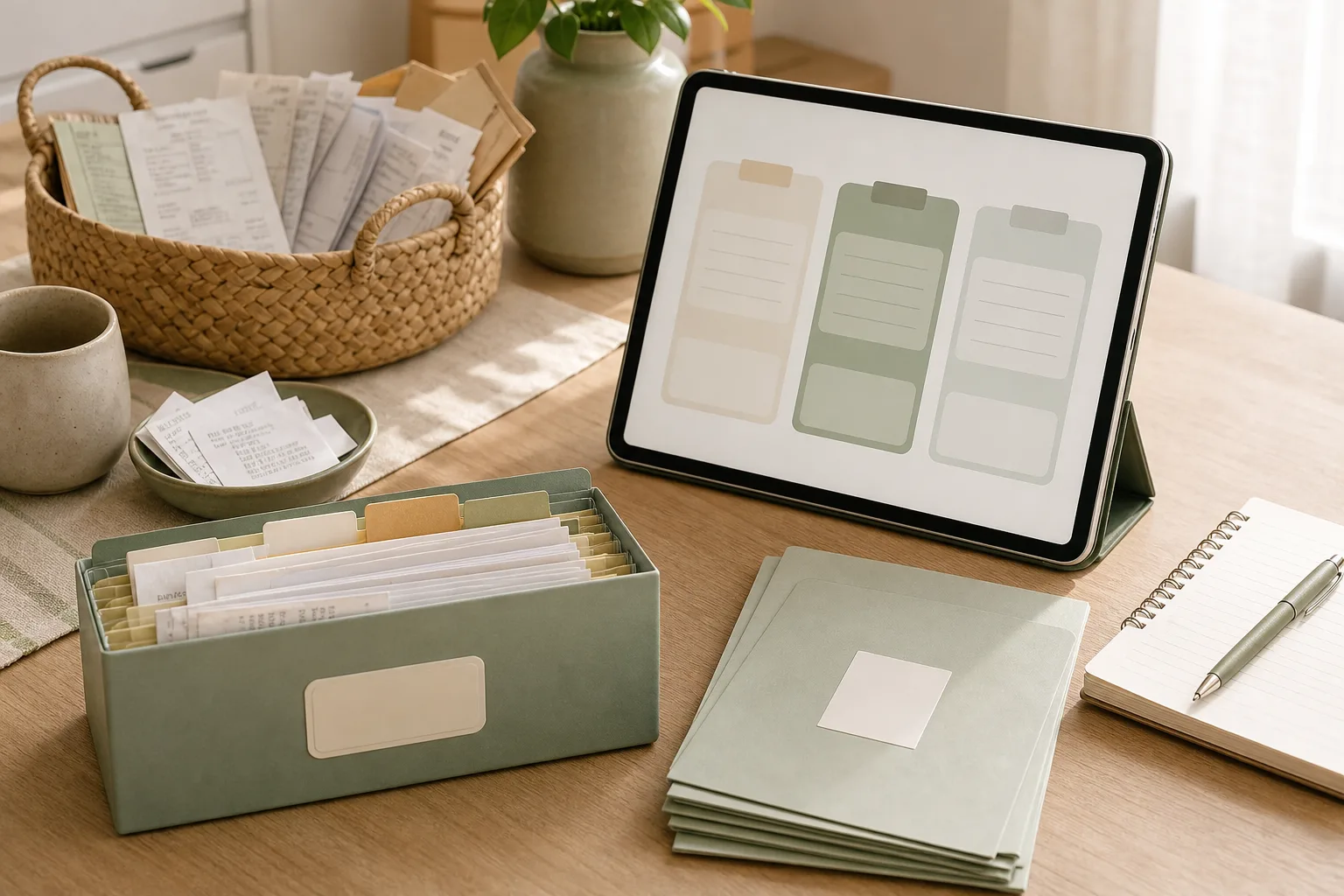
  • A 15-Minute Monthly Receipt Archive for Household Spending

    A 15-Minute Monthly Receipt Archive for Household Spending

    작성자: Kai Life Editorial Team

    A simple monthly receipt archive can be created in 15 minutes by gathering the month’s receipts, separating items by action, recording only useful details, and storing the final notes in one consistent place. The aim is not to build a detailed accounting system. It is to make household spending records easy to find when you need to check a purchase, notice a recurring payment, or compare one month with another.

    A 15-Minute Monthly Receipt Archive for Household Spending — topic illustration

    Why a small archive is easier to maintain

    Receipts become difficult to use when they are scattered across wallets, bags, email inboxes, shopping apps, and screenshots. A monthly archive gives each record a clear home and a short review point. It can also separate three different needs that are often mixed together:

    • Reference: keeping enough information to identify a purchase later.
    • Action: marking a receipt that needs a return, warranty check, reimbursement, or follow-up.
    • Awareness: recording patterns such as subscriptions, routine bills, or unusually large household purchases.

    Keeping those purposes separate helps prevent over-recording. A receipt that only needs to be found later may need a date, merchant, amount, and short note. It may not need every product line copied into a spreadsheet.

    The Prepare–Sort–Act–Review framework

    1. Prepare: create one monthly landing place

    Choose one physical or digital location for the month. This could be a labeled envelope, a folder, a note, or a spreadsheet tab. Use a naming pattern that is easy to scan, such as 2025-03 Household Spending. The specific tool matters less than having one predictable destination.

    Before starting, collect the records that are easiest to overlook:

    • Paper receipts from wallets, bags, or drawers.
    • Email receipts and order confirmations.
    • App purchase histories or screenshots.
    • Notes about cash purchases.
    • Recurring payment notices that arrived during the month.

    Set a timer for 15 minutes. The time limit keeps the task focused on useful organization rather than a complete reconstruction of every transaction.

    2. Sort: use three action piles

    Sort each record into one of three groups:

    Group Use it for Next step
    Keep Purchases that may be useful to reference later File or save a short record
    Act Returns, missing items, warranty questions, or reimbursements Add a clear follow-up note
    Discard or merge Duplicates, unreadable scraps, or records already stored elsewhere Remove only after checking for a useful copy

    When a purchase exists in both paper and digital form, keep the format that is easier for the household to retrieve. If a physical receipt contains information that is not visible in the digital copy, retain the physical version or add a note before disposing of anything.

    3. Act: write the minimum useful record

    For each item in the Keep group, record a small set of details. A practical entry can include:

    • Date or month
    • Merchant or service name
    • Amount, if relevant to your household review
    • Category or purpose
    • Return, warranty, reimbursement, or other follow-up date
    • A short identifying note, such as “replacement filter” or “school supplies”

    Use plain descriptions that another household member can understand. “Home item” may be too vague six months later, while “kitchen storage container” is more useful. The note should identify the purchase without requiring a long explanation.

    Recurring payments deserve a separate mark. Add a small label such as recurring or renewal when a charge repeats monthly, annually, or on another schedule. This does not require a financial analysis. It simply makes repeated charges easier to spot during a later review.

    4. Review: close the month with a short check

    Use the final minutes to check whether the archive answers the questions your household is likely to ask. For example:

    • Can we identify the source of this purchase?
    • Is any receipt waiting for a return or other action?
    • Did we record the recurring payments that need attention?
    • Are there duplicate records that can be merged?
    • Would another person find this archive without asking where it is?

    If a record does not answer a realistic question, avoid adding detail simply to make the archive look complete. The purpose is retrieval and review, not creating a second copy of every shopping history.

    A timed 15-minute action plan

    This schedule can be adjusted to fit the number of records in the month.

    Time Task Output
    Minutes 0–2 Open the monthly folder or prepare the envelope and gather loose records One working area
    Minutes 2–6 Separate records into Keep, Act, and Discard or merge Three clear groups
    Minutes 6–11 Record the minimum useful details for Keep items A searchable monthly list
    Minutes 11–13 Mark recurring payments and follow-up items Visible action labels
    Minutes 13–15 Complete one action and store the archive A closed monthly routine

    If the timer ends while records remain, stop at a sensible point and label the unfinished group. You can carry it into the next session rather than allowing the archive task to expand without a boundary.

    Copyable monthly archive table

    Use this table as a starting point. Remove columns that do not help your household and add a column only when it supports a repeated decision.

    Date Merchant or service Amount Purpose Recurring? Action or note
    YYYY-MM-DD Yes / No
    YYYY-MM-DD Yes / No
    YYYY-MM-DD Yes / No

    For a paper-first system, the same information can fit on a monthly cover sheet. For a digital system, use a note or spreadsheet that can be searched by merchant, purpose, or month. Avoid mixing personal notes with sensitive payment details that are not needed for household organization.

    Decision rules that keep the routine simple

    Keep a receipt when it has a future use

    A record is more useful when it supports a likely future task: finding purchase information, checking a return window, identifying a replacement item, or answering a household question. If the receipt has no practical reference value and another reliable record already exists, it may not need a separate duplicate.

    Write a note when the receipt is unclear

    Some merchant names do not explain what was purchased. Add a short purpose note while the transaction is still familiar. This is particularly helpful for mixed shopping trips or orders containing several household items.

    Separate follow-up from storage

    A filed receipt can disappear from attention. An action note should state what needs to happen and when you plan to revisit it. For example, “check return status on Friday” is more useful than “return?” A calendar reminder may be appropriate for an item with a time-sensitive follow-up.

    Use categories that match household decisions

    Categories should help you review records, not reproduce a complicated accounting chart. Examples include groceries, household supplies, transport, children’s items, personal care, and home maintenance. If two categories lead to the same decision, combine them.

    Monthly checklist

    • Choose the monthly folder, note, envelope, or table.
    • Gather paper, email, app, and cash-purchase records.
    • Sort each item into Keep, Act, or Discard or merge.
    • Record the date, merchant, amount, purpose, and useful note.
    • Mark recurring payments or renewal-related records.
    • Write a specific follow-up for every Act item.
    • Remove duplicates only after confirming another copy is available.
    • Store the finished archive where household members can find it.

    FAQ

    Should every receipt be entered?

    No. The archive can focus on records that support retrieval, follow-up, or a household review. The right level of detail depends on how your household uses the records and how much information is already available elsewhere.

    Is a spreadsheet required?

    No. A folder, note, envelope, or paper cover sheet can work. Choose a format that is easy to update and easy for the people in the household to locate.

    How should digital and paper receipts be combined?

    Choose one monthly location and add a short pointer when the original stays somewhere else. For example, a monthly note can state that the full digital receipt is in a named email folder. Avoid saving several indistinguishable copies without a reason.

    What if the archive is already several months behind?

    Start with the current month and create a short backlog list for older records. Prioritize items connected to an open action or a likely future question. A complete historical archive is not required to begin a usable routine.

    Conclusion

    A monthly receipt archive works best when it reduces searching rather than adding another demanding chore. Gather records in one place, sort them by action, record only useful details, mark recurring payments, and close the session with a short review. Repeating the same four steps gives household spending organization a stable shape while leaving room to adjust the format to your household’s actual needs.


  • A 15-Minute Weekly Work Review: Six Questions to Organize Your Week

    A 15-Minute Weekly Work Review: Six Questions to Organize Your Week

    작성자: Kai Life Editorial Team

    A 15-minute weekly work review can give you a clearer starting point for the next few workdays. The aim is not to rebuild your entire task system. Instead, collect loose information, identify the few items that need attention, and decide the next visible action for each priority.

    A 15-Minute Weekly Work Review: Six Questions to Organize Your Week — topic illustration

    This routine uses six questions in four stages: prepare, sort, act, and review. You can complete it with a notebook, a plain text file, or the tools you already use for tasks and meeting notes.

    The six questions for a weekly work review

    1. What is still open? Gather unfinished tasks, promises, follow-ups, meeting notes, and ideas from the past week.
    2. What changed? Mark new information, changed deadlines, blocked work, and requests that affect your plans.
    3. What matters most next? Choose the small set of outcomes that deserve attention before lower-value work.
    4. What is the next physical or digital action? Convert each important item into a concrete step that can be started.
    5. What needs a person, decision, or boundary? Identify items waiting on someone else, unclear requests, and work that needs a scope or time limit.
    6. When will I look again? Place a review point or reminder so open loops do not depend on memory alone.

    The questions are intentionally plain. A review becomes harder to maintain when it requires complicated labels, extensive scoring, or a separate system for every type of work.

    Prepare: collect information without organizing it yet

    Begin by opening the places where work has accumulated. These may include your task list, calendar, email flags, meeting notes, chat messages, project documents, and a paper notebook. Do not try to solve each item during this first pass.

    Question 1: What is still open?

    Write down incomplete work and commitments that could otherwise remain hidden. Include small items such as sending a file, checking a detail, confirming an appointment, or returning a message. A short list is easier to review when each line describes one item.

    Use neutral wording. “Client project” is broad, while “add the revised timeline to the project document” gives you a clearer starting point. You can refine vague items later.

    Question 2: What changed?

    Scan the past week for changes rather than rereading every message. Look for:

    • new deadlines or shifted deadlines;
    • requests that changed in scope;
    • decisions made in meetings;
    • tasks blocked by missing information;
    • items that no longer need action.

    For meeting notes, capture the decision, the owner, and the next follow-up. If one of those details is missing, mark it as an open question instead of assuming the answer.

    Sort: choose priorities and clarify the work

    After collecting information, reduce the list. A weekly review is not a second inbox. It is a short decision point about where your attention should go next.

    Question 3: What matters most next?

    Choose a limited number of priority outcomes for the coming week. The right number depends on your workload, role, and deadlines, so avoid treating a fixed number as a universal rule. A useful priority should describe an outcome, not just an activity.

    For example, “work on presentation” is difficult to evaluate. “Complete the first draft of the presentation for internal review” gives the item a clearer finish line. If several items compete, consider:

    • which deadline is closest or least flexible;
    • which item affects other people’s ability to work;
    • which decision would remove a significant delay;
    • which commitment has already been made;
    • which task supports the most important current outcome.

    Items that do not belong in the next week can be moved to a later list, parked with a review date, or deleted if they no longer represent a real commitment.

    Question 4: What is the next physical or digital action?

    Break each priority into a first step that can be done without further interpretation. Useful action verbs include draft, compare, send, schedule, confirm, outline, review, upload, or ask.

    If the next step is “wait for an answer,” record who needs to respond, what you are waiting for, and when you will follow up. If the item is too large for one sitting, write the next part rather than listing the whole project as a task.

    Question 5: What needs a person, decision, or boundary?

    Some work stays open because it is not a task problem. It may require a decision, clarification, approval, or conversation. Label these items so you do not repeatedly treat them as personal execution work.

    Examples include:

    • asking a colleague to confirm which version is current;
    • requesting a decision before continuing a draft;
    • setting a response time for a non-urgent request;
    • agreeing on what will not fit within the available time;
    • recording an assumption that could affect the result.

    A boundary can be a time limit, a defined deliverable, or a statement of what is outside the current scope. This makes the work easier to discuss with others and easier to revisit later.

    Act and review: turn the list into a usable plan

    Question 6: When will I look again?

    Give important open items a future review point. This may be a calendar reminder, a dated task, or a line in next week’s review note. The purpose is not to predict every detail. It is to create a reliable place where unfinished work can be reconsidered.

    Then place the next actions where you will see them during the week. Keep the working list short enough to scan. Supporting detail can stay in project notes, while the weekly list shows the next action and any relevant date.

    A 15-minute action plan

    Time Stage Action
    0–3 minutes Prepare Collect open tasks, calendar items, meeting notes, messages, and loose reminders.
    3–6 minutes Sort Mark what changed and remove items that are no longer active.
    6–10 minutes Prioritize Choose the next important outcomes and write one next action for each.
    10–13 minutes Clarify Identify waiting items, needed decisions, follow-ups, and scope boundaries.
    13–15 minutes Review Add dates or reminders, place the list where you work, and note the first starting action.

    If the review reaches 15 minutes with unresolved questions, record those questions and stop. A short review can be more sustainable when it has a clear endpoint. Complex project planning can happen separately when it is genuinely needed.

    Copyable weekly work checklist

    Copy the following template into your preferred notes or task tool:

    WEEKLY WORK REVIEW
    Date:
    
    PREPARE
    [ ] Open tasks collected
    [ ] Calendar and meeting notes checked
    [ ] Follow-ups and loose reminders captured
    
    SORT
    [ ] What is still open?
    [ ] What changed?
    [ ] Items no longer relevant removed or parked
    
    ACT
    [ ] What matters most next?
    [ ] Next action written for each priority
    [ ] Waiting, decision, and boundary items marked
    [ ] Follow-ups assigned a person and date where possible
    
    REVIEW
    [ ] Future review points added
    [ ] First starting action identified
    [ ] List placed where it will be visible

    You can also use a compact table when you need more context:

    Open item Next action Type Review point
    Do / wait / decide / clarify
    Do / wait / decide / clarify
    Do / wait / decide / clarify

    How to keep the routine lightweight

    Use one capture location. Information can come from many places, but the review output should have one visible home. This reduces the need to remember where a decision was recorded.

    Separate projects from next actions. A project may contain many steps, while the weekly review needs the next step that can move it forward.

    Keep waiting work visible but distinct. A task that depends on another person should not look identical to a task you can start immediately.

    Do not over-rank every task. A simple distinction between priority, later, waiting, and no longer relevant may be enough for a small workload.

    Adjust the questions to your role. A support role may need more follow-up tracking, while a creative role may need more space for drafts and decisions. The framework is a starting structure rather than a rigid method.

    FAQ

    When should I do a weekly work review?

    Choose a time near the end of one work period or the beginning of the next, when you can see recent changes and upcoming commitments. The best timing is one you can repeat without creating conflict with urgent work.

    What if I have too many open tasks?

    Start by removing duplicates and items that no longer represent a real commitment. Then separate tasks you can do from items waiting for information or approval. If the remaining workload still exceeds available time, use the review to identify trade-offs and discuss scope with the relevant person.

    Should meeting notes be included?

    Yes, when they contain decisions, commitments, or follow-ups. You do not need to copy every discussion point. Extract the action, owner, context, and review date when those details are available.

    What if 15 minutes is not enough?

    Finish the capture and identify the highest-value next actions first. Add a separate planning session for a complex project rather than allowing one difficult item to consume the entire weekly review.

    Conclusion

    A useful weekly work review can be small: collect what is open, note what changed, choose what matters next, define the next action, clarify dependencies, and set a future review point. The six questions provide a repeatable structure without requiring a new productivity platform. Start with the checklist, keep the output visible, and refine the routine when your work patterns show that a different prompt or category would be more useful.


THANKS KAI CONTACT

WeChat

위챗에서 QR코드를 스캔해 주세요.
Scan the QR code in WeChat.

Thanks Kai WeChat contact QR code위챗 열기 / Open WeChat